

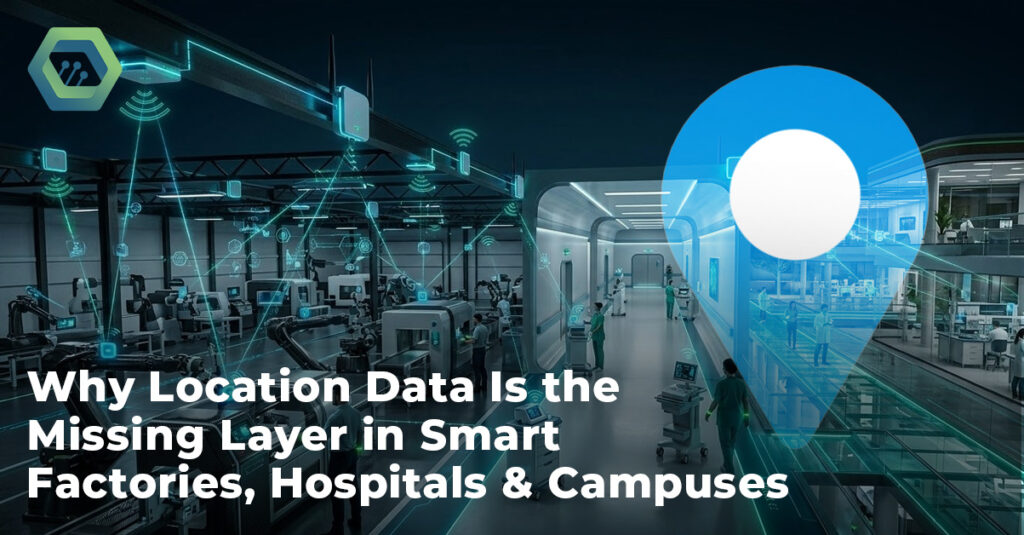
Introduction: The Invisible Data Layer Most Smart Systems Miss
Organisations worldwide are investing heavily in IoT platforms, predictive analytics, automation, and AI-driven operations. Smart factories monitor machines, hospitals track patient data, and campuses optimise energy usage.
Yet one critical layer of intelligence is still missing in many deployments:
Location data.
Knowing where assets, equipment, personnel, or devices are in real time is the key to unlocking the next level of operational efficiency.
Without location intelligence, IoT systems generate data but lack context.
That’s where RTLS (Real-Time Location Systems) powered by IoT sensors come in.
What Is IoT Location Data?
IoT location data refers to real-time positional information of assets, equipment, people, or vehicles using sensors and wireless technologies.
Common technologies include:
- UWB (Ultra Wideband)
- LoRaWAN tracking
- BLE beacons
- RFID sensors
- GPS for outdoor tracking
These technologies create real-time location intelligence layers on top of existing IoT platforms.
When integrated with the OmniWOT IoT Cloud Platform, location data becomes actionable insights.
Why Location Data Matters in Industrial IoT
Smart infrastructure generates massive amounts of sensor data.
However, without knowing where events are happening, decision-making remains incomplete.
Location intelligence enables:
• Real-time asset tracking
• Worker safety monitoring
• Workflow optimisation
• Equipment utilisation analysis
• Emergency response improvements
This is why RTLS adoption in Industry 4.0 environments is growing rapidly.
Smart Factories: Unlocking Operational Visibility
Manufacturing facilities operate with thousands of assets:
- Tools
- Machines
- Forklifts
- Raw materials
- Personnel
Without location tracking, valuable time is lost searching for equipment or diagnosing workflow bottlenecks.
With RTLS and IoT sensors, factories gain:
Real-Time Asset Tracking
Track tools, machines, and materials across production floors.
Worker Safety Monitoring
Monitor worker movement in hazardous zones.
Production Flow Optimisation
Analyse movement patterns to improve process efficiency.
OmniWOT integrates RTLS sensors, LoRaWAN devices, and IoT dashboards to deliver complete factory visibility.
Hospitals: Saving Time and Saving Lives
Healthcare environments depend on fast access to critical equipment.
Common challenges include:
- Missing medical equipment
- Delayed patient response
- Inefficient resource allocation
Location intelligence solves this through hospital RTLS systems.
Track Medical Equipment
Locate ventilators, infusion pumps, or wheelchairs instantly.
Monitor Patient Movement
Ensure patient safety and improve care coordination.
Improve Staff Efficiency
Reduce time spent searching for devices or rooms.
OmniWOT’s wearables, IoT platform, and RTLS tracking technologies provide healthcare facilities with actionable visibility.
Smart Campuses: Managing Complex Infrastructure
Universities, corporate campuses, and smart cities manage vast infrastructures including:
- Buildings
- Security systems
- Vehicles
- Utility equipment
Location data enables centralized monitoring through a single IoT dashboard.
Benefits include:
Security Monitoring
Track movement of personnel and assets.
Resource Optimization
Understand how facilities are utilized.
Emergency Response
Locate people quickly during incidents.
With OmniWOT’s multi-protocol IoT platform, campuses can integrate RTLS with existing infrastructure.
Technologies Powering Location Intelligence
Modern location tracking systems combine multiple technologies to improve accuracy.
UWB (Ultra Wideband)
Provides centimeter-level indoor positioning.
LoRaWAN Tracking
Enables long-range tracking across industrial campuses.
BLE Beacons
Low-cost indoor tracking for asset monitoring.
IoT Sensors and Gateways
Transmit location data to centralized platforms.
OmniWOT’s multi-protocol IoT platform supports LoRaWAN, BLE, and RTLS integration, allowing businesses to deploy scalable tracking solutions.
Real Business Impact of Location Data
Organizations implementing location intelligence report:
• Reduced equipment search time
• Faster emergency response
• Improved asset utilization
• Increased worker safety
• Reduced operational losses
In many cases, ROI is achieved within the first year of deployment.
The Role of the IoT Platform in Location Intelligence
Location sensors alone are not enough.
Organizations need a unified IoT platform that can:
- Collect sensor data
- Visualize location in real time
- Trigger alerts and automation
- Integrate with existing systems
OmniWOT’s IoT platform combines:
• RTLS tracking
• LoRaWAN sensor connectivity
• Digital twin visualization
• Real-time dashboards
• predictive analytics
This creates a single source of truth for operational intelligence.
The Future: Context-Aware Industrial Intelligence
The next generation of IoT systems will combine:
- Sensor data
- Location intelligence
- AI analytics
- automation
This combination will enable fully autonomous operations in factories, hospitals, and campuses.
Location data will become the context layer powering smart decision-making.
Conclusion
Smart industries rely on data to drive efficiency.
But data without context is incomplete.
Location intelligence provides the missing layer that connects assets, people, and infrastructure in real time.
By combining RTLS, IoT sensors, and unified platforms like OmniWOT, organizations can transform operations, improve safety, and unlock new efficiencies.
In the future of Industry 4.0, location data will be as important as sensor data itself.