

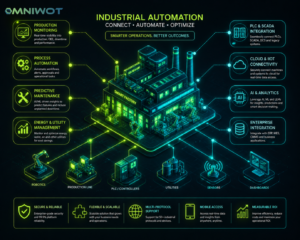
The Fragmented Shop-Floor Dilemma Walk through any modern manufacturing plant today, and you will witness a high degree of technical sophistication. Robotic arms weld with precision, and CNC machines execute complex milling cycles. Additionally, Programmable Logic Controllers (PLCs) govern high-speed assembly lines. Yet, when you look behind the scenes at how operational data is managed, a frustrating reality emerges. The

Industrial IoT Platform: Connect, Monitor & Automate Everything In today’s fast-paced digital world, industries are increasingly relying on Internet of Things (IoT) sensors and smart devices to monitor operations. However, managing separate platforms for energy monitoring, industrial equipment, building controls, and utility infrastructure often creates data silos, increases complexity, and elevates operational costs. Enter OMNIWOT—a centralized, unified IoT platform designed

OmniWOT — The New Benchmark in Multi-Protocol IoT Platforms An Multi-Protocol IoT Platform should be more than a place to connect sensors and view data. Real-world IoT needs connectivity, device management, dashboards, automation, integration, and scalability—all working together. One Platform. Multiple Possibilities. OmniWOT brings together: Hardware-Agnostic IoT Multi-Protocol Connectivity — LoRaWAN, MQTT, Modbus, BACnet, OPC UA, BLE, and more Device

IoT platform for system integrators — Install Any Sensors. OmniWOT Takes Care of the Rest. “When looking for an IoT platform for system integrators, OmniWOT helps you…” As an IoT or ELV System Integrator, your focus should be simple: Understand the customer, select the right hardware, install, integrate, commission, deliver, and support. But every IoT project also needs a software
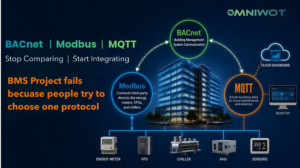
BACnet vs Modbus vs MQTT: Stop Comparing. Start Integrating. In BMS projects, one question comes up again and again: “Should we use BACnet, Modbus or MQTT?” The better question is: “Where should each protocol be used?” Because in a practical building automation architecture, BACnet, Modbus and MQTT are not necessarily competitors. They can work together. What Does Each Protocol Do?
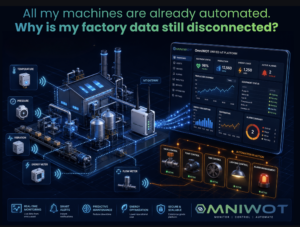
Your Factory Is Automated. So Why Is It Still Disconnected? 🏭 Ask any Engineering Manager: “Can you get production, machine, energy and maintenance data from your entire factory in one place?” The answer is often: Yes… but not that easily. The PLC has the data. The SCADA has the data. The CNC machine has the data. The energy meter has

Can We Just Change the Logic in the DDC Controller? If you’ve worked on BMS projects in India or the Middle East, you’ve probably heard this question: “Can we just change the logic in the DDC?” It usually sounds simple. Until the consultant changes the sequence. The client adds another condition. The facility team wants a different operating mode. A
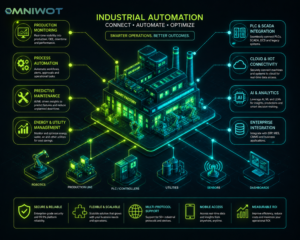
Industrial Integration & Smart Factory Digitization: From Disconnected Machines to Unified Operational Intelligence Walk through any modern manufacturing plant today, and you will witness high technical sophistication. Robotic arms weld with precision, CNC machines run complex milling cycles, and PLCs control assembly lines. However, behind the scenes, a frustrating reality emerges: operational systems remain disconnected. The Fragmented Shop-Floor Dilemma Most
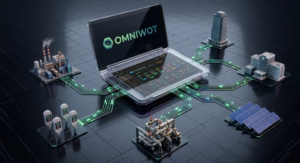
Industrial IoT Platform: Connect, Monitor & Automate Everything In today’s fast-paced digital world, industries increasingly rely on Internet of Things (IoT) sensors to monitor operations. However, managing separate platforms for energy, industrial equipment, building controls, and utilities creates data silos, increases complexity, and elevates operational costs. Enter OMNIWOT—a unified IoT platform designed to bring all your smart ecosystems together under
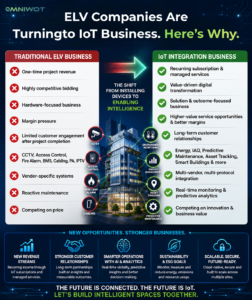
ELV Companies Are Turning to the IoT Business. Here’s Why. The Changing Landscape of the ELV Industry For decades, Extra-Low Voltage (ELV) System Integrators have served as the backbone of modern infrastructure. In the past, companies built strong businesses around core installations. These included CCTV, Access Control, Fire Alarms, Structured Cabling, Public Address systems, IPTV, and conventional Building Management Systems
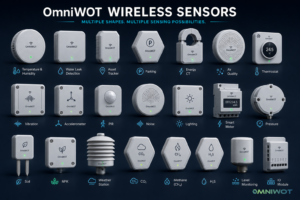
Industrial IoT Sensors: A Complete Guide to Smart Sensors & IoT Devices In today’s data-driven world, real-time monitoring and automation are essential for industrial efficiency, smart cities, precision agriculture, and commercial infrastructure. OmniWOT Wireless Sensors provide a comprehensive ecosystem designed with a simple philosophy: Multiple Shapes. Multiple Sensing Possibilities. Whether you need to monitor indoor air quality, track industrial machinery

IoT Wearable Devices for Worker Safety: A Complete Guide The Blind Spots of Industrial Safety Walk into a heavy manufacturing facility, a deep underground mine, or a sprawling oil refinery, and you will see workers wearing standard Personal Protective Equipment (PPE)—hard hats, high-visibility vests, and steel-toed boots. While traditional PPE provides essential physical defense against impacts, it remains fundamentally passive.