
The Future of Industry Isn’t Built on New Machines—It’s Built on Better Connections
Across manufacturing plants, commercial buildings, utilities, logistics hubs, and industrial facilities, organizations have invested heavily in automation.
Factories operate with PLCs.
Production lines rely on SCADA systems.
Buildings are equipped with BMS platforms.
Machines generate millions of data points every day.
Yet despite these investments, many digital transformation initiatives fail to deliver their expected business outcomes.
Why?
Because the systems powering industrial operations often speak different languages.
This is where Industrial Integration becomes the foundation of modern digital transformation.
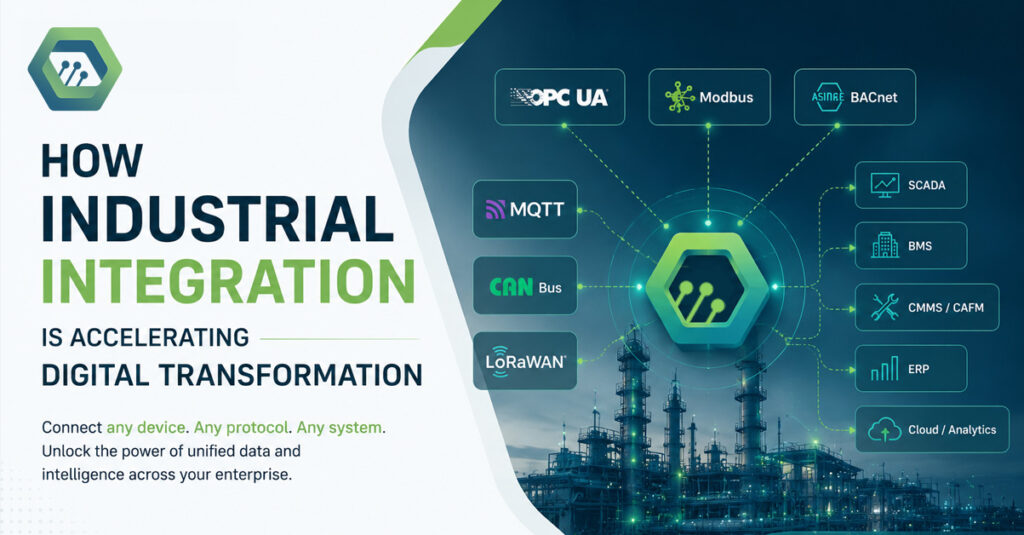
By integrating industrial communication protocols, enterprises can connect legacy equipment, modern IoT devices, enterprise applications, and cloud analytics into one intelligent ecosystem.
What Is Industrial Protocol Integration?
Industrial Protocol Integration is the process of connecting devices, controllers, machines, sensors, and enterprise systems that communicate using different industrial protocols.
Instead of replacing existing infrastructure, organizations integrate multiple technologies into a unified operational platform.
Common industrial protocols include:
- Modbus RTU / TCP
- BACnet
- OPC UA
- MQTT
- CAN Bus
- LoRaWAN
- DNP3
- SNMP
- KNX
- M-Bus
- IEC 61850
- REST APIs
- HTTPS
A modern Industrial Integration platform translates these protocols into a common language, enabling seamless communication between operational technology (OT) and information technology (IT).
Why Protocol Integration Matters More Than Ever
Digital transformation is no longer about installing more devices.
It is about making existing systems work together.
Most enterprises already own:
- PLC Controllers
- SCADA Platforms
- Building Management Systems
- Energy Meters
- Industrial Sensors
- ERP Applications
- CMMS & CAFM Platforms
- Utility Monitoring Systems
Without Industrial Integration, each platform becomes another isolated source of data.
The result is fragmented operations and delayed decisions.
The Hidden Cost of Disconnected Protocols
When systems cannot communicate effectively, organizations experience:
Data Silos
Critical operational information remains trapped within individual systems.
Manual Data Collection
Teams spend valuable time exporting reports and consolidating information manually.
Delayed Decision-Making
Business leaders lack real-time operational visibility.
Higher Integration Costs
Point-to-point integrations become difficult to maintain as organizations scale.
Limited Automation
Disconnected systems prevent automated workflows and predictive analytics.
How Industrial Integration Accelerates Digital Transformation
Unified Operational Visibility
Industrial Integration brings together machines, utilities, buildings, and enterprise systems into one operational view.
Instead of multiple dashboards, organizations gain one centralized platform.
Legacy Equipment Modernization
One of the biggest challenges in digital transformation is aging infrastructure.
Replacing legacy PLCs or industrial equipment is expensive and disruptive.
Industrial Integration enables organizations to connect legacy assets without replacing them.
This protects previous investments while extending the value of existing infrastructure.
Real-Time Decision Making
Industrial protocols continuously transmit operational data.
Once integrated, organizations gain instant visibility into:
- Production
- Energy
- Maintenance
- Utilities
- Equipment Performance
Decision-makers no longer wait for reports—they act in real time.
Predictive Maintenance
Industrial Integration combines sensor data with operational history and maintenance records.
Organizations can detect:
- Equipment degradation
- Temperature anomalies
- Vibration issues
- Power fluctuations
- Motor performance changes
Maintenance becomes predictive rather than reactive.
Enterprise-Wide Intelligence
Industrial Integration connects operational technology with business systems.
Examples include:
- SCADA ↔ ERP
- PLC ↔ MES
- BMS ↔ Energy Analytics
- IoT Sensors ↔ CMMS
This creates complete operational context.
Common Industrial Integration Use Cases
Manufacturing
Integrate:
- PLC
- SCADA
- MES
- ERP
- IoT Sensors
Benefits:
✔ Improved OEE
✔ Production Visibility
✔ Reduced Downtime
✔ Predictive Maintenance
Smart Buildings
Connect:
- HVAC
- Lighting
- Fire Systems
- Access Control
- Energy Meters
- BMS
Benefits:
✔ Intelligent Building Operations
✔ Lower Energy Costs
✔ Occupancy-Based Automation
✔ Centralized Facility Management
Energy & Utilities
Integrate:
- Grid Infrastructure
- Renewable Energy
- Smart Meters
- Water Systems
Benefits:
✔ Consumption Analytics
✔ Demand Forecasting
✔ Utility Optimization
✔ Sustainability Reporting
Logistics
Connect:
- Fleet Tracking
- Fuel Systems
- Warehouse Operations
- Asset Tracking
Benefits:
✔ Fleet Optimization
✔ Fuel Savings
✔ Real-Time Visibility
✔ Better Resource Planning
OT Meets IT: The Foundation of Industry 4.0
Operational Technology (OT) manages industrial processes.
Information Technology (IT) manages business processes.
Historically, these environments operated independently.
Industrial Integration bridges this gap.
When OT and IT work together, organizations achieve:
- Faster Decisions
- Better Analytics
- AI Readiness
- Enterprise Visibility
- Operational Intelligence
This convergence is one of the defining characteristics of Industry 4.0.
Why Unified IoT Platforms Depend on Industrial Integration
A Unified IoT Platform cannot function effectively without protocol integration.
Its ability to connect multiple systems relies on seamless communication across industrial protocols.
Through Industrial Integration, a Unified IoT Platform can:
- Collect data from diverse assets
- Normalize information
- Correlate operational events
- Trigger automated workflows
- Deliver enterprise-wide analytics
This transforms disconnected devices into a connected operational ecosystem.
How OmniWOT Enables Industrial Integration
OmniWOT is designed as a Unified Multi-Protocol IoT Platform capable of integrating legacy and modern industrial environments.
Multi-Protocol Connectivity
Support for:
- BACnet
- Modbus
- OPC UA
- MQTT
- LoRaWAN
- CAN Bus
- REST APIs
- HTTPS
- And many more
Edge-to-Cloud Architecture
Real-time edge processing combined with cloud analytics enables secure and scalable deployments.
Enterprise Integration
Connect:
- PLC
- SCADA
- ERP
- MES
- CAFM
- CMMS
- Building Management Systems
Through a single operational intelligence platform.
Scalable Deployment
Deploy across:
- Manufacturing Plants
- Commercial Buildings
- Campuses
- Utilities
- Airports
- Hospitals
- Smart Cities
Without replacing existing infrastructure.
Best Practices for Successful Industrial Integration
Organizations should:
- Prioritize open communication protocols
- Preserve legacy investments where possible
- Standardize operational data
- Integrate OT and IT systems
- Build scalable edge-to-cloud architectures
- Implement cybersecurity best practices
- Use centralized operational dashboards
These practices create a future-ready digital foundation.
Frequently Asked Questions
What is Industrial Integration?
Industrial Integration connects machines, industrial protocols, enterprise applications, and IoT platforms to enable seamless communication and operational intelligence.
Why is protocol integration important?
Protocol integration eliminates data silos, enables real-time visibility, supports predictive maintenance, and accelerates digital transformation.
Which protocols are commonly used?
BACnet, Modbus, OPC UA, MQTT, LoRaWAN, CAN Bus, DNP3, KNX, M-Bus, IEC 61850, and REST APIs.
Can Industrial Integration work with legacy equipment?
Yes. Modern integration platforms like OmniWOT connect existing industrial infrastructure without requiring complete replacement.
How does Industrial Integration support Industry 4.0?
It creates the connected ecosystem required for AI, predictive maintenance, digital twins, automation, and enterprise analytics.
Conclusion
Industrial transformation is no longer driven by automation alone.
The organizations leading Industry 4.0 are connecting machines, buildings, utilities, sensors, and enterprise systems into unified operational ecosystems.
Industrial Integration makes this possible.
By connecting diverse industrial protocols through one intelligent platform, enterprises gain:
✔ Real-Time Visibility
✔ Operational Intelligence
✔ Predictive Maintenance
✔ Lower Operational Costs
✔ Faster Decision-Making
✔ Scalable Digital Transformation
The future of industrial operations isn’t about replacing infrastructure.
It’s about connecting it.
And Industrial Integration is the bridge that makes digital transformation possible.