
The Data-Driven Farm: Why Precision Analytics and IoT Are the Future of Food Security
The agricultural sector is undergoing a massive, tech-driven transformation. For generations, large-scale commercial agribusinesses relied on a mix of historical weather patterns, regional forecasts, and generational intuition. But in an era marked by volatile climate shifts, depleting water tables, and fluctuating market demands, yesterday’s guesswork is today’s financial risk.
The future of global food security relies on precision analytics—shifting from a reactive model of farming to a proactive, automated operation powered by the Internet of Things (IoT).
The Shift from Intuition to Real-Time Telemetry
Traditional soil science and agronomy have always provided a strong foundation, but they have historically suffered from a data latency problem. Testing soil quality or manual tracking can take days or weeks. By the time a commercial grower notices a crop bed is underwatered or experiencing nutrient stress, the yield potential has already taken a hit.
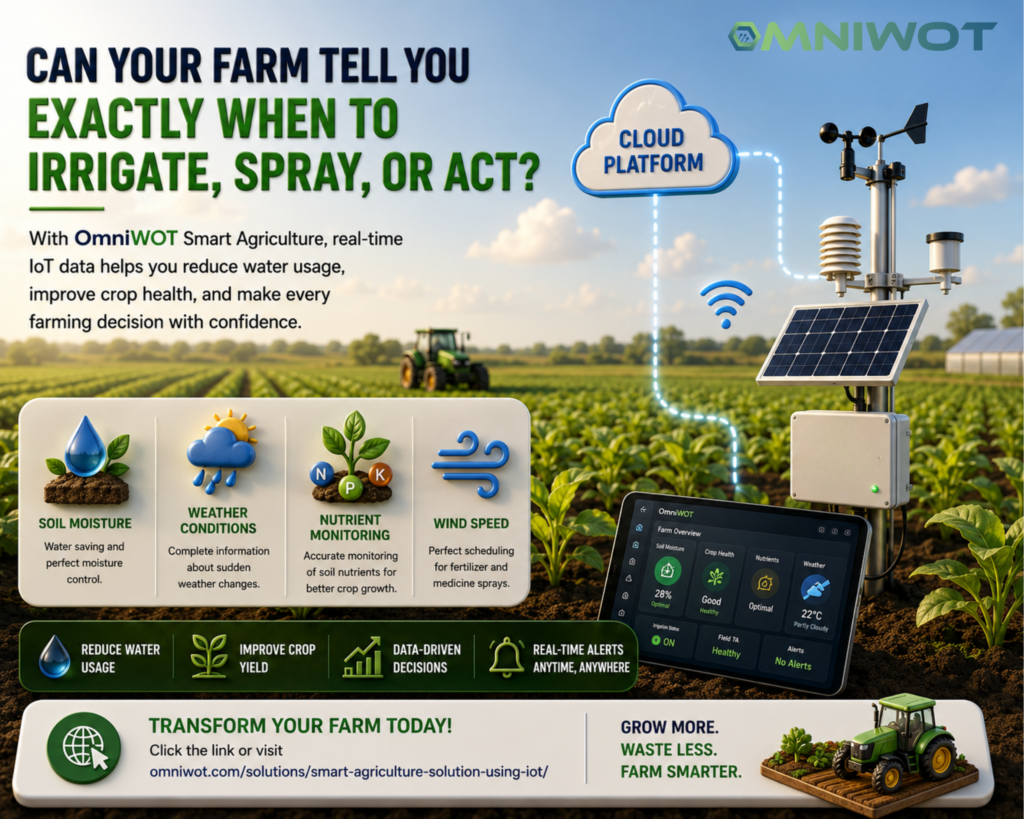
IoT bridges this gap by deploying a robust, wireless mesh of smart field nodes across an agricultural estate. These nodes continuously stream hyper-local environmental telemetry directly to a centralized cloud command center.
Key Advantage: Instead of managing a farm as a single, massive unit, operators can manage it at a micro-level—individual crop beds, specific zones, and precise intervals.
4 Critical Metrics Transforming Modern Agribusiness
Smart farming isn’t just about collecting data for data’s sake; it’s about capturing actionable variables that directly impact resource allocation and crop health.
Plaintext
[Wireless Mesh Sensors] ---> [Cloud Analytics] ---> [Automated Action/Dashboard]
          |                                                   |
          +--> Soil, Weather, Solar, Wind Metrics ------------+
1. Soil Moisture Analytics
Water is one of the most heavily mismanaged resources in traditional farming. Over-irrigation leaches nutrients from the soil and breeds disease, while under-irrigation stunts growth. Smart sensors deliver volumetric water content data in real time, allowing for precision irrigation control. Water is applied exactly when and where it is needed, driving down utility costs and conserving local water supplies.
2. Hyper-Local Weather Tracking
Macro weather forecasts cover broad regions, but a large agribusiness estate can span microclimates where conditions vary drastically from one square mile to the next. Localized atmospheric sensors track immediate shifts in temperature, humidity, and barometric pressure, giving farm managers an early warning system against sudden frost, heatwaves, or unexpected downpours.
3. Solar Radiation Monitoring
Sunlight fuels photosynthesis, but tracking it accurately goes beyond counting hours of daylight. By indexing solar radiation and accumulated light intensity, analytics engines can calculate crop growth cycles with mathematical precision. This data helps predict harvest windows, map out rotation schedules, and assess the photosynthetic efficiency of different crop varieties.
4. Wind Speed Metrics
Managing large fields requires targeted chemical applications, including liquid fertilizers and pesticides. Spraying during high or erratic winds leads to chemical drift—wasting expensive product, risking environmental contamination of neighboring lands, and failing to protect the target crop. Real-time wind speed indicators allow managers to schedule optimal, compliant spraying windows.
Protecting Yields and Maximizing ROI
Transitioning to a data-driven framework directly influences an agro-enterprise’s bottom line in three distinct ways:
-
Resource Waste Elimination: Precise inputs mean less wasted water, fewer chemicals purchased, and lower fuel consumption for machinery.
-
Climate Resilience: Real-time alerts allow farms to adapt defensively to sudden weather anomalies before they damage vulnerable crops.
-
Predictable Output: Standardizing growing environments through automation results in consistent crop quality and higher overall yields, satisfying strict supply chain agreements.
Conclusion
The digitization of the field is no longer a luxury reserved for experimental farms—it is the baseline infrastructure for any commercial operation looking to scale sustainably. By connecting the physical earth to cloud networks, precision agriculture ensures that global food systems can remain resilient, predictable, and profitable for decades to come.
To see how modern wireless mesh networks can automate your estate’s environmental tracking, explore the engineered capabilities of the Smart Agriculture Solution using IoT.