

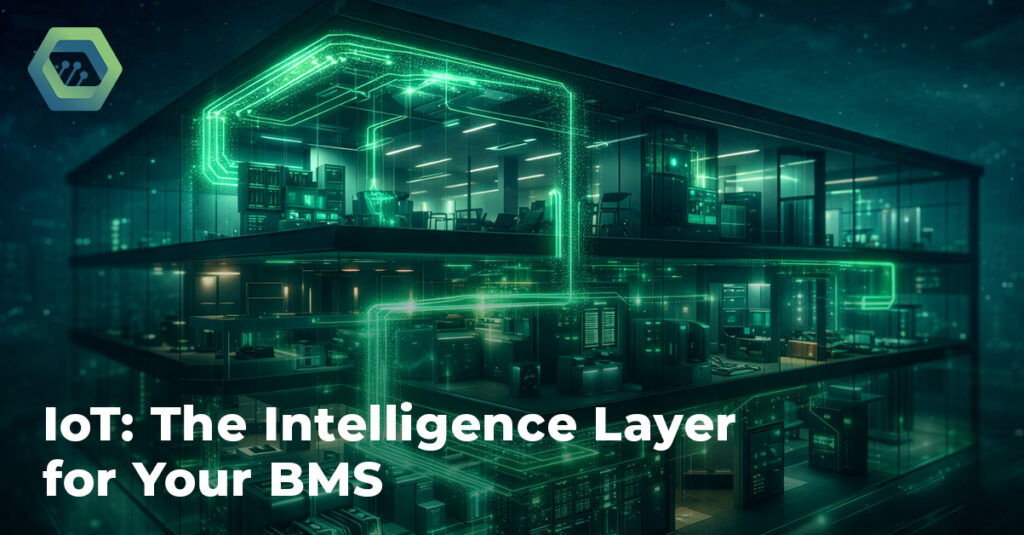
BMS can’t be replaced — but IoT is the layer that unlocks its full value.
Building Management Systems remain the backbone of smart buildings. They reliably operate HVAC, chillers, electrical infrastructure, and life safety systems using BACnet and Modbus protocols.
That foundation isn’t changing.
What is changing is client expectation.
Today’s enterprises demand:
- Lower Energy Costs
- Clear, Measurable ROI
- Multi-site visibility
- Easy IoT installation & Seamless Integration
- ONE Operational Dashboard
Traditional control alone is no longer enough.
IoT doesn’t compete with BMS.
It strengthens it — adding intelligence, enterprise connectivity, and scalable analytics on top of your existing infrastructure.
1️⃣ Building Management Systems and IoT — Different Strengths
Think of it this way:
BMS is deep > IoT is wide.
A BMS is purpose-built for smart buildings. It controls:
- HVAC systems
- Chillers
- Electrical systems
- Steam and water networks
- Fire and safety systems
IoT platforms, on the other hand, are designed to monitor and connect assets across industries, including:
- Manufacturing equipment
- Mining operations
- Agriculture deployments
- Warehouses
- Renewable energy systems
- Commercial buildings
Now consider your enterprise clients.
If they operate corporate offices plus factories, warehouses, or distributed facilities, the BMS cannot unify that operational data.
An IoT platform can.
And it can do so without disturbing the BMS backbone.
2️⃣ Combining IoT and BMS — What It Looks Like On Site
This is not theory. This is practical integration.
An IoT platform connects through:
- BACnet IP
- Modbus TCP
- Secure edge gateways
- No controller replacement.
- No logic rewrite.
- No rip-and-replace strategy.
Your BMS continues executing real-time control. Now layer additional intelligence:
- CO₂ sensors enabling demand-based ventilation
- Energy meters tracking equipment-level consumption
- Weather data driving predictive cooling
- Occupancy inputs optimizing runtime schedules
The BMS remains the control engine.
The IoT layer enhances decision-making and enterprise visibility.
The operational outcome:
- Lower peak demand charges
- Smarter HVAC sequencing
- Reduced energy wastage
- Measurable, reportable ROI
This shifts the conversation from technical integration to business performance.
3️⃣ Platforms That Bridge BMS and Enterprise Operations
Enterprise-grade IoT platforms such as OmniWOT demonstrate how BMS integration can scale beyond individual buildings.
These platforms can:
- Ingest BACnet and Modbus data
- Normalize multi-site information
- Combine building and industrial datasets
- Deliver centralized dashboards
- Enable advanced analytics beyond traditional BMS capabilities
Instead of isolated site-level BMS screens, corporate leadership gains:
- Cross-property performance comparisons
- Energy benchmarking across portfolios
- Centralized command and control
- Single-pane operational visibility
This is where BMS evolves into an enterprise-ready system.
4️⃣ One Platform for Hyper-Enterprise Corporations
Large corporations don’t just manage buildings.
They operate:
- Corporate offices
- Manufacturing plants
- Warehouses
- Data Centers
- Mining
- Oil & Gas
- Agriculture
- Remote operational sites
Each environment generates valuable operational data — typically managed in silos.
An IoT layer unifies them. All from a single operational interface.
With the right platform, organizations can:
- Monitor smart building systems
- Track industrial equipment performance
- Compare energy usage across regions
- Automate alerts enterprise-wide
For BMS integrators, this changes market positioning significantly.
You’re no longer delivering standalone building automation.
You’re delivering integrated operational intelligence.
The Strategic Takeaway
BMS is the foundation. IoT is the expansion layer.
BMS handles deterministic, real-time building control.
IoT connects that building to the broader enterprise ecosystem.
#IOT+BMS #OmniWOT-BMS #OmniWOT_IBMS #OmniWOT_CAFM