
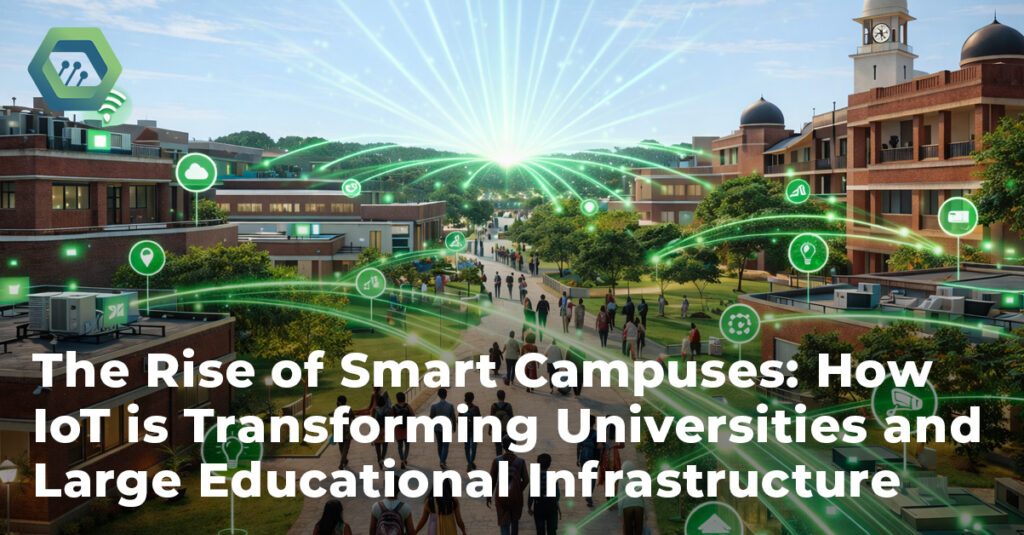
Universities today are no longer just academic institutions.
They operate like mini cities, managing infrastructure, utilities, safety, and thousands of occupants daily.
From classrooms and hostels to labs and auditoriums, the scale and complexity of campus operations are rapidly increasing.
This shift is driving the rise of Smart Campuses powered by IoT—where infrastructure becomes connected, intelligent, and efficient.
What is a Smart Campus?
A Smart Campus uses IoT technology to connect and manage infrastructure, assets, and environments through a centralized digital platform.
It enables real-time monitoring, automation, and data-driven decision-making across campus operations.
In simple terms:
A Smart Campus transforms traditional infrastructure into a connected, intelligent ecosystem
Why Universities Need Smart Campus Solutions
Large educational institutions face multiple operational challenges:
• Managing energy consumption across buildings
• Ensuring student safety and security
• Maintaining air quality and comfort
• Handling maintenance across multiple assets
• Optimizing space utilization
Traditional systems operate in silos, making it difficult to manage everything efficiently.
👉 IoT bridges this gap by creating a unified operational layer
Key Components of a Smart Campus IoT Ecosystem
1. Environmental Monitoring
Track air quality, temperature, and humidity across classrooms, labs, and hostels.
2. Energy Management
Monitor electricity consumption and optimize usage across campus buildings.
3. Smart Lighting & HVAC
Automate lighting and climate systems based on occupancy and schedules.
4. Safety & Security
Enable real-time monitoring of fire systems, access control, and emergency alerts.
5. Asset & Facility Management
Track equipment, manage maintenance, and ensure operational efficiency.
Centralized Campus Management
One of the biggest advantages of IoT is centralized visibility.
A unified IoT platform enables universities to:
• Monitor all buildings from a single dashboard
• Track real-time performance of systems
• Receive alerts for anomalies or failures
• Automate maintenance workflows
👉 From fragmented systems to one connected command center
Improving Student Experience
Smart campuses don’t just optimize operations—they enhance student life.
IoT enables:
• Better indoor air quality in classrooms
• Comfortable temperature control
• Reduced downtime of facilities
• Improved safety and response systems
Result:
👉 Healthier, safer, and more productive learning environments
Energy Efficiency & Sustainability
Universities are among the largest consumers of energy.
IoT-driven systems help:
• Monitor energy usage in real time
• Identify inefficiencies
• Reduce wastage
• Optimize HVAC and lighting
👉 Supporting sustainability goals and reducing operational costs
Predictive Maintenance for Campus Infrastructure
Campus infrastructure includes thousands of assets:
• HVAC systems
• Electrical panels
• Elevators
• Lab equipment
IoT sensors combined with analytics enable:
• Early detection of issues
• Predictive maintenance
• Reduced downtime
• Extended asset life
Scalability Across Large Campuses
Smart campus solutions are designed to scale across:
• Multiple buildings
• Large geographical areas
• Thousands of devices and sensors
With a unified IoT platform, campuses can grow without increasing complexity.
Real-World Use Cases
Universities
Centralized monitoring of classrooms, labs, and hostels
Engineering Campuses
Equipment monitoring and predictive maintenance
Residential Campuses
Energy optimization and smart utilities
Research Institutions
Controlled environments and lab monitoring
Benefits of Smart Campus IoT
1. Operational Efficiency
Automate and streamline campus management
2. Cost Optimization
Reduce energy and maintenance costs
3. Improved Safety
Real-time alerts and faster response
4. Better Resource Utilization
Optimize space and infrastructure
5. Data-Driven Decisions
Use insights to improve planning and operations
The Role of Unified IoT Platforms
A Smart Campus is only as effective as the platform behind it.
Unified IoT platforms bring together:
• Sensors and devices
• Building systems (BMS, HVAC, lighting)
• Analytics and dashboards
• Automation workflows
👉 Enabling complete campus intelligence from a single platform
The Future of Smart Campuses
The next phase of smart campuses will include:
• AI-driven automation
• Digital twins of campus infrastructure
• Autonomous energy optimization
• Advanced predictive analytics
Campuses will evolve into fully intelligent ecosystems that adapt in real time.
Conclusion
The rise of smart campuses is not a trend—it’s a necessity.
With IoT, universities can:
• Improve operational efficiency
• Enhance student experience
• Reduce costs
• Enable sustainable infrastructure
👉 From traditional campuses to connected, intelligent environments
FAQ
What is a smart campus?
A smart campus uses IoT technology to connect and manage infrastructure, enabling real-time monitoring and automation.
How does IoT help universities?
IoT improves energy efficiency, safety, maintenance, and overall campus operations through real-time data.
What are the benefits of smart campus solutions?
Improved efficiency, reduced costs, better safety, enhanced student experience, and data-driven decision-making.
Which systems are connected in a smart campus?
HVAC, lighting, energy systems, security systems, environmental sensors, and facility management systems.
Transform Your Campus into a Smart Ecosystem
Discover how OmniWOT enables universities to build connected, efficient, and future-ready campus infrastructure.
👉 Contact us to get started