

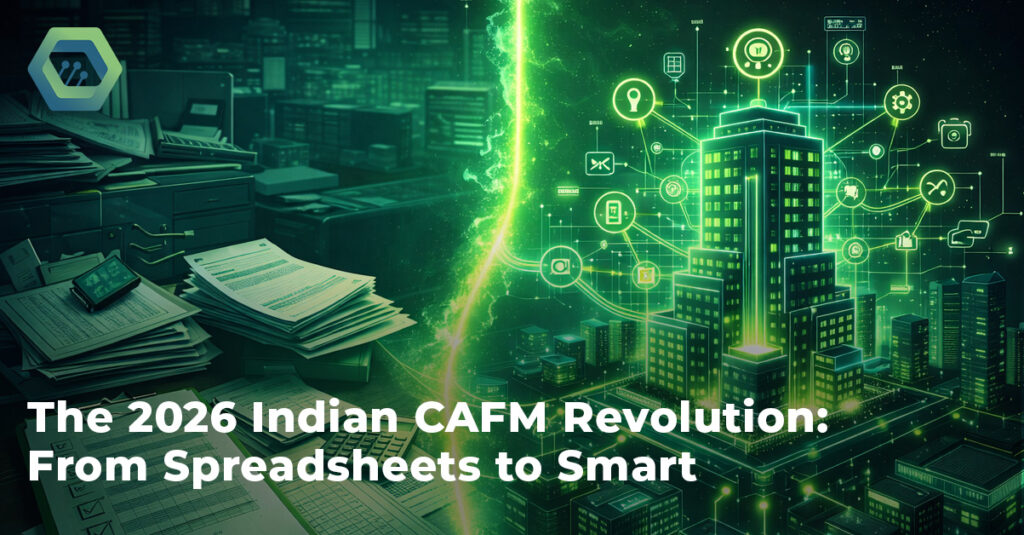
●Facility Management in India is undergoing a massive transformation.
What was once managed through spreadsheets, manual logs, and reactive workflows is now evolving into real-time, intelligent, and connected systems powered by CAFM, IoT, and automation.
Welcome to the 2026 CAFM Revolution in India.
The Shift: From Manual to Digital
For years, facility operations in India relied on:
• Excel sheets for asset tracking
• Manual work order systems
• Reactive maintenance
• Disconnected vendor management
These systems created:
❌ Delays in decision-making
❌ Lack of real-time visibility
❌ High operational inefficiencies
❌ Limited scalability
👉 Today, enterprises are moving towards smart CAFM platforms
Why CAFM Adoption is Accelerating in India
India’s facility management ecosystem is expanding rapidly.
- The market is projected to grow significantly, reaching $7.7 billion by 2034 with strong CAGR growth
- Driven by commercial real estate, smart cities, and infrastructure expansion
Key Drivers Behind CAFM Adoption
1. Rapid Infrastructure Growth
Large campuses, IT parks, hospitals, and industrial zones demand structured facility management systems.
2. Smart Cities & Government Push
Initiatives like Smart Cities Mission and infrastructure investments are accelerating tech-enabled FM adoption.
3. Demand for Efficiency & Cost Control
Enterprises are shifting toward data-driven operations with measurable KPIs.
4. Rise of IoT & Automation
IoT sensors and automation are making predictive maintenance and real-time monitoring possible.
What is CAFM (Computer-Aided Facility Management)?
CAFM is a digital platform that centralizes facility operations, including:
• Asset management
• Maintenance workflows
• Space utilization
• Energy monitoring
• Vendor & SLA tracking
👉 It replaces fragmented tools with a single intelligent system
CAFM vs Traditional Facility Management
| Traditional FM | CAFM Platform |
|---|---|
| Manual tracking | Real-time dashboards |
| Reactive maintenance | Predictive maintenance |
| Data silos | Unified data platform |
| Delayed reporting | Instant insights |
| Limited scalability | Enterprise-ready |
The Role of IoT in the CAFM Revolution
CAFM alone digitizes operations.
IoT makes it intelligent.
With IoT Integration:
• Sensors track asset performance in real time
• Systems trigger automated alerts
• Maintenance workflows are auto-generated
• Energy consumption is optimized
👉 CAFM + IoT = Smart Facility Management
From Spreadsheets to Smart Platforms
The biggest shift in 2026 is not just digital—it’s intelligent automation.
Earlier:
Facility teams depended on manual updates
Now:
Platforms like OmniWOT enable:
• Real-time monitoring
• Automated workflows
• Multi-site control
• Centralized dashboards
👉 From tracking data → to acting on insights
CAFM Use Cases Across India
IT Parks & Corporate Offices
Centralized monitoring of HVAC, energy, and occupancy
Hospitals
Critical asset tracking and compliance management
Manufacturing Plants
Predictive maintenance and downtime reduction
Campuses & Institutions
Smart infrastructure and energy optimization
Key Benefits of CAFM Platforms
1. Real-Time Visibility
Monitor all assets and operations from one dashboard
2. Predictive Maintenance
Detect failures before they occur
3. Cost Optimization
Reduce energy waste and operational costs
4. Improved SLA Compliance
Track vendor performance and response times
5. Scalability
Manage multiple facilities seamlessly
The Rise of Integrated Facility Management (IFM)
Indian enterprises are moving toward Integrated Facility Management (IFM)
Instead of multiple vendors and systems:
👉 A single platform manages everything
This includes:
• Maintenance
• Security
• Energy
• Waste management
• Compliance
👉 CAFM becomes the digital backbone of IFM
Emerging Trends in 2026
1. AI + Predictive Analytics
Facilities are becoming proactive and self-learning
2. Unified IoT Platforms
All systems connected into one intelligent dashboard
3. ESG & Sustainability
Energy monitoring and carbon tracking becoming mandatory
4. Mobile-First Facility Management
Real-time updates and operations via mobile apps
5. Digital Twin Integration
Virtual replicas for advanced monitoring and simulation
Challenges in CAFM Adoption
Despite growth, some barriers exist:
• Legacy infrastructure
• Resistance to change
• Integration complexity
• Initial implementation cost
👉 However, modern platforms solve this with scalable, retrofit-friendly solutions
Why Enterprises Are Moving Fast Now
The shift is no longer optional.
Organizations are realizing that:
- Manual systems cannot scale
- Data is critical for decision-making
- Efficiency directly impacts profitability
👉 CAFM is no longer a tool
👉 It is a strategic infrastructure layer
OmniWOT: Enabling the CAFM Transformation
OmniWOT brings CAFM into the next generation by integrating:
• IoT sensors
• BMS systems
• Asset intelligence
• Automation workflows
• Unified dashboards
Result:
👉 Complete visibility
👉 Intelligent operations
👉 Enterprise scalability
Conclusion
India’s CAFM revolution is not just about replacing spreadsheets—
it’s about transforming how facilities operate.
With smart platforms, IoT integration, and real-time intelligence:
• Operations become proactive
• Costs become optimized
• Facilities become intelligent
👉 From manual management to data-driven infrastructure
❓ FAQ (AEO OPTIMIZED – FEATURED SNIPPETS)
What is CAFM software in India?
CAFM software is a digital platform used to manage facility operations such as maintenance, assets, and energy in real time.
Why is CAFM important in 2026?
CAFM enables automation, predictive maintenance, and real-time visibility, making it essential for modern infrastructure.
What is the difference between CAFM and CMMS?
CAFM focuses on overall facility management, while CMMS focuses specifically on maintenance operations.
How is IoT used in CAFM?
IoT sensors provide real-time data that enables automated workflows, predictive maintenance, and better decision-making.