Global industries are scaling faster than ever.
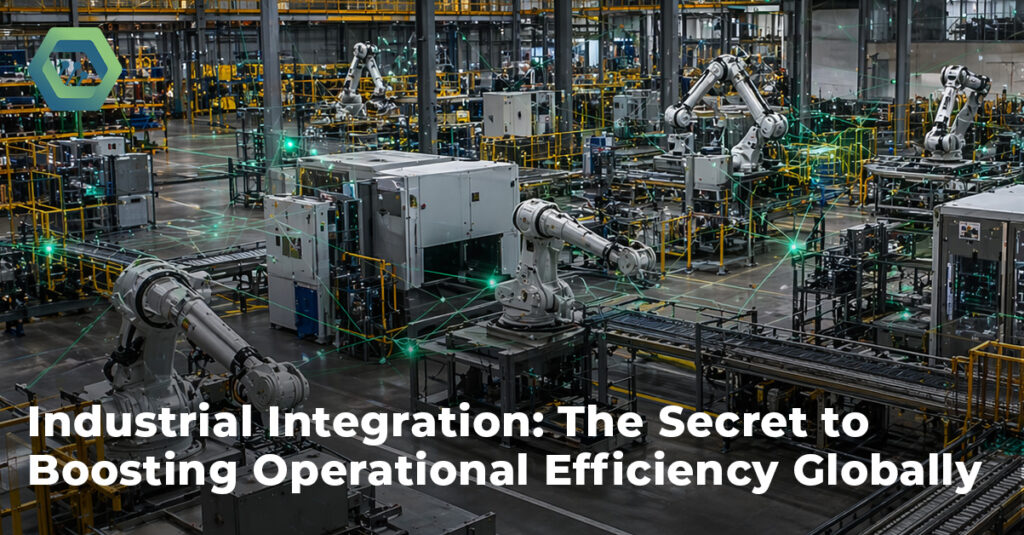
But with scale comes complexity—multiple machines, systems, locations, and data sources.
The real challenge is not operations.
It’s integration.
Today, the most efficient enterprises are not the ones with the most advanced machines—
but the ones with the most connected systems.
What is Industrial Integration?
Industrial Integration is the process of connecting machines, systems, and data across an industrial environment into a single unified platform.
It brings together:
• Machines & production lines
• PLC, SCADA & control systems
• IoT sensors & gateways
• Energy & utility systems
• Maintenance & asset platforms
👉 Result: One system. One view. Total control.
The Problem: Disconnected Industrial Ecosystems
Many industrial environments still operate in silos:
• Separate dashboards for machines
• Manual maintenance tracking
• Standalone energy monitoring
• Limited cross-system visibility
This leads to:
❌ Data silos
❌ Delayed decision-making
❌ Increased downtime
❌ Inefficient operations
❌ Higher costs
👉 Without integration, scale becomes a problem—not an advantage
The Shift: From Systems to Ecosystems
Modern industries are moving from isolated systems to connected ecosystems.
Instead of managing components separately,
everything is integrated into a central intelligence layer.
This enables:
• Real-time monitoring
• Cross-system insights
• Automated workflows
• Faster decision-making
The Role of IoT in Industrial Integration
IoT acts as the connective tissue between physical assets and digital systems.
With IoT-enabled integration:
• Sensors capture real-time machine data
• Systems communicate using standardized protocols
• Data flows into a centralized platform
• Insights are generated instantly
👉 Transforming operations from reactive to predictive and intelligent
Edge-to-Cloud: The Foundation of Scalable Integration
Industrial integration is powered by an edge-to-cloud architecture:
Edge Layer
• Processes data locally
• Enables real-time control
• Reduces latency
Cloud Layer
• Centralizes analytics
• Enables multi-site monitoring
• Scales across global operations
👉 Speed at the edge. Intelligence in the cloud.
What Industrial Integration Actually Enables
1. Real-Time Operational Visibility
Monitor machines, assets, and processes across locations from one dashboard
2. Predictive Maintenance
Identify issues before failures occur
3. Energy Optimization
Track and optimize energy usage across operations
4. Automated Workflows
Trigger actions without manual intervention
5. Multi-Site Control
Manage global operations centrally
Industrial Integration in Action
Smart Factories
Connected production lines with real-time monitoring
Manufacturing Plants
Integrated PLC, SCADA, and IoT systems
Energy-Intensive Industries
Optimized energy consumption and cost control
Global Enterprises
Unified operations across multiple countries
From Integration to Automation
Integration is not the end goal—
it’s the foundation for automation.
Once systems are connected:
• Machines can communicate with each other
• Workflows can be automated
• Processes can self-optimize
👉 Leading to intelligent, autonomous operations
Challenges in Industrial Integration
• Legacy system compatibility
• Multiple protocols (Modbus, BACnet, OPC-UA)
• Data security concerns
• Integration complexity
Modern Platforms Solve This With:
✔ Multi-protocol support
✔ Scalable architecture
✔ Secure edge-to-cloud communication
✔ Retrofit-friendly deployment
The Role of Unified IoT Platforms
Industrial integration requires a central intelligence platform.
Unified IoT platforms bring together:
• Sensors & machines
• Industrial protocols
• Data analytics
• Dashboards & automation
👉 Enabling complete control from a single system
The Future: Autonomous Industrial Ecosystems
Industrial operations are evolving toward:
• AI-driven predictive systems
• Digital twins of factories
• Autonomous process optimization
• Real-time global decision-making
👉 Integration will be the backbone of Industry 4.0 and beyond
Business Impact
Enterprises adopting industrial integration experience:
• Higher operational efficiency
• Reduced downtime
• Lower operational costs
• Improved productivity
• Scalable global operations
👉 Efficiency is no longer optional—it’s a competitive advantage
Conclusion
Industrial Integration is no longer a technical upgrade—
it is a business transformation strategy.
By connecting systems, data, and operations into one unified platform,
enterprises can move from:
❌ Reactive operations
to
✅ Intelligent, data-driven ecosystems
📢 CTA
Integrate Everything. Optimize Everywhere.
Discover how OmniWOT enables seamless industrial integration with a unified IoT platform.
👉 Get in touch to build smarter, connected industrial operations
❓ FAQ
What is industrial integration?
Industrial integration connects machines, systems, and data into a unified platform for better control and efficiency.
Why is industrial integration important?
It improves efficiency, reduces downtime, and enables real-time decision-making.
What technologies are used in industrial integration?
IoT, PLC, SCADA, edge computing, and cloud platforms.
How does IoT help industrial integration?
IoT collects real-time data and enables communication between systems, making operations intelligent and automated.