
Every Industry is Digitized. Very Few Are Connected.
Digital transformation has become a boardroom priority across industries.
Manufacturers have invested in automation.
Commercial buildings have adopted smart systems.
Utilities have deployed monitoring infrastructure.
Logistics companies have embraced digital tracking platforms.
Yet despite significant investments in technology, a common challenge remains:
Most systems still operate independently.
The result is a digital environment filled with valuable data that rarely works together.
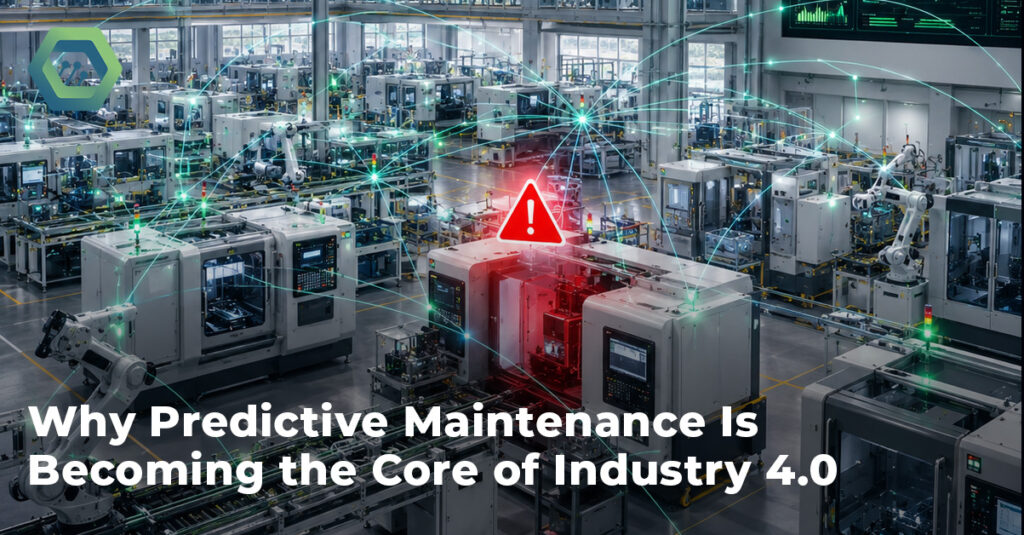
And that is precisely why Predictive Maintenance is rapidly becoming one of the most important pillars of Industry 4.0.
The Reality Across Industries
Modern enterprises are not lacking technology.
They are lacking operational synchronization.
Manufacturing
Production systems, maintenance teams, energy monitoring, and quality management often operate on separate platforms.
A machine may show signs of failure, but maintenance teams only discover it after production is impacted.
Smart Buildings
HVAC systems, lighting controls, fire alarms, access control, and energy management systems frequently operate in silos.
Critical operational insights remain trapped inside individual systems instead of contributing to building-wide intelligence.
Energy & Utilities
Organizations manage distributed assets across substations, pumping stations, solar farms, and utility networks.
Without unified visibility, asset performance becomes difficult to optimize at scale.
Logistics & Supply Chain
Fleet management, fuel consumption, warehouse operations, and asset tracking often reside on disconnected platforms.
Operational bottlenecks become difficult to identify before they affect service delivery.
The Hidden Cost of Disconnected Operations
When systems cannot communicate effectively, organizations face more than technical challenges.
They face business challenges.
Delayed Decision-Making
Teams spend valuable time gathering information from multiple systems before acting.
By the time insights are available, opportunities may already be lost.
Operational Blind Spots
Equipment degradation often goes unnoticed until failure occurs.
Without connected intelligence, organizations are forced into reactive maintenance strategies.
Increased Downtime
Unexpected equipment failures lead to production interruptions, service disruptions, and costly emergency repairs.
Higher Operational Costs
Manual inspections, unnecessary maintenance activities, energy inefficiencies, and poor asset utilization all contribute to rising costs.
Disconnected Data = Missed Business Value
Every industrial asset generates data.
Every building system generates data.
Every operational process generates data.
The challenge is not collecting information.
The challenge is converting information into intelligence.
Disconnected data creates isolated insights.
Connected data creates business value.
Why Predictive Maintenance Has Become Essential
Traditional maintenance strategies generally fall into two categories:
Reactive Maintenance
Fix equipment after failure occurs.
This approach often results in:
• Higher repair costs
• Unplanned downtime
• Production losses
• Reduced asset lifespan
Preventive Maintenance
Service equipment based on fixed schedules.
While better than reactive maintenance, this approach often leads to:
• Unnecessary maintenance activities
• Higher labor costs
• Inefficient resource allocation
Predictive Maintenance
Predictive maintenance uses real-time data, IoT sensors, analytics, and machine intelligence to determine the actual condition of equipment.
Maintenance is performed only when required.
This approach enables organizations to:
✔ Detect failures before they occur
✔ Reduce downtime significantly
✔ Improve asset reliability
✔ Optimize maintenance resources
✔ Extend equipment life
The Role of Industry 4.0
Industry 4.0 is not simply about automation.
It is about creating connected industrial ecosystems where systems communicate continuously and intelligently.
This includes:
• IoT Sensors
• SCADA Systems
• PLC Controllers
• ERP Platforms
• Building Management Systems
• Energy Monitoring Systems
• AI Analytics Platforms
When these systems work together, predictive maintenance becomes possible.
From Monitoring to Intelligence
Most organizations already monitor their equipment.
The real value comes when monitoring evolves into intelligence.
For example:
A vibration sensor detects abnormal motor behaviour.
↓
The IoT platform identifies a pattern indicating bearing degradation.
↓
A maintenance work order is generated automatically.
↓
The maintenance team receives an alert.
↓
The issue is resolved before operational disruption occurs.
No manual analysis.
No unexpected downtime.
No reactive firefighting.
This is predictive maintenance in action.
Why Unified IoT Platforms Matter
Predictive maintenance cannot succeed in fragmented environments.
It requires a unified operational layer capable of integrating data from multiple systems.
A Unified IoT Platform enables:
Centralized Visibility
Monitor all assets from a single dashboard.
Cross-System Intelligence
Correlate data from machines, utilities, environmental sensors, and operational systems.
Automated Workflows
Trigger alerts, maintenance tasks, and escalation procedures automatically.
Enterprise Scalability
Deploy predictive maintenance strategies across multiple sites and facilities.
Real Business Outcomes
Organizations implementing predictive maintenance commonly achieve:
Reduced Downtime
Identify issues before failure occurs.
Lower Maintenance Costs
Service equipment based on actual condition.
Improved Asset Utilization
Increase operational availability and performance.
Better Energy Efficiency
Detect inefficient equipment behavior early.
Improved Operational Reliability
Create consistent and predictable operations.
The Future: Autonomous Operations
The next evolution of Industry 4.0 is moving beyond predictive maintenance.
Organizations are beginning to adopt:
• AI-driven diagnostics
• Digital twins
• Autonomous asset optimization
• Self-healing systems
Predictive maintenance serves as the foundation for these advanced capabilities.
Without connected data, autonomous operations remain impossible.
OmniWOT: Connecting Data, Assets, and Intelligence
OmniWOT enables organizations to transform fragmented operational environments into connected digital ecosystems.
By integrating:
• Industrial IoT Sensors
• PLC & SCADA Systems
• Building Management Systems
• Energy Monitoring Infrastructure
• Enterprise Applications
OmniWOT creates a unified platform where predictive maintenance becomes a natural outcome of connected operations.
Conclusion
Industry 4.0 is no longer defined by automation alone.
The organizations creating the greatest competitive advantage are those that connect systems, synchronize data, and transform operational information into intelligence.
Predictive maintenance sits at the center of this transformation.
Because the future of operational excellence is not simply knowing what happened.
It is knowing what will happen next.
And acting before it does.
Frequently Asked Questions
What is Predictive Maintenance?
Predictive maintenance uses IoT sensors, analytics, and real-time monitoring to predict equipment failures before they occur.
Why is Predictive Maintenance important in Industry 4.0?
It reduces downtime, lowers maintenance costs, and improves operational efficiency through data-driven decisions.
How does IoT enable Predictive Maintenance?
IoT sensors continuously collect equipment performance data that can be analyzed to identify anomalies and predict failures.
What industries benefit from Predictive Maintenance?
Manufacturing, smart buildings, energy & utilities, logistics, transportation, healthcare, and industrial facilities.
What is the difference between Preventive and Predictive Maintenance?
Preventive maintenance follows fixed schedules, while predictive maintenance is based on actual equipment condition and real-time data.