
The End of Dashboard Overload
Modern enterprises have never had more visibility into their operations.
Buildings have Building Management Systems (BMS).
Factories use SCADA and PLC platforms.
Energy teams monitor utility consumption.
Facility managers rely on CAFM and CMMS software.
Logistics teams use fleet and asset tracking platforms.
Industrial operations deploy hundreds or even thousands of IoT sensors.
Yet despite this abundance of technology, many organizations continue to struggle with a common problem:
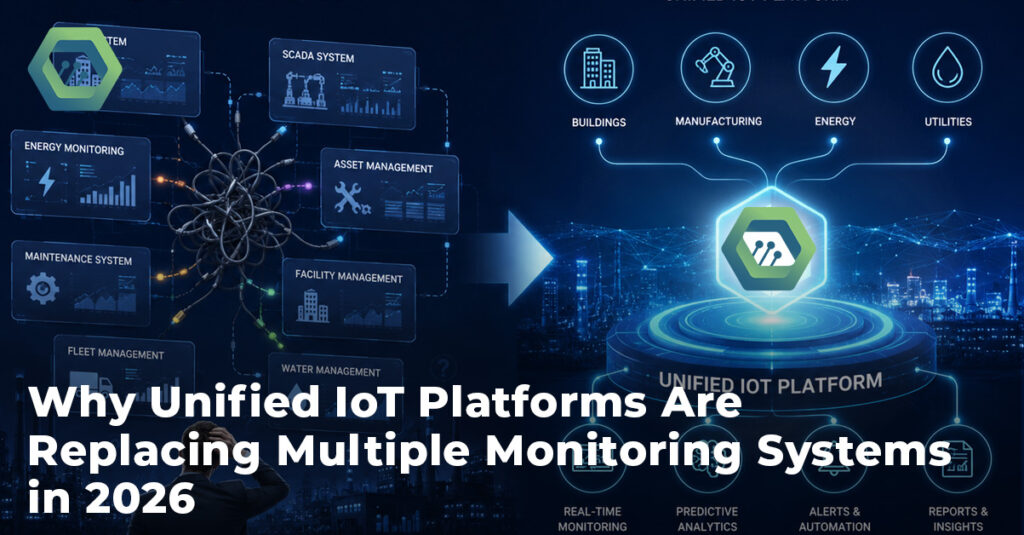
Too many systems. Too many dashboards. Too little intelligence.
This is why the Unified IoT Platform is rapidly becoming the foundation of digital transformation in 2026.
Organizations are moving away from fragmented monitoring tools and embracing a centralized platform capable of connecting assets, infrastructure, operations, and business systems into one intelligent ecosystem.
What Is a Unified IoT Platform?
A Unified IoT Platform is a centralized technology framework that integrates devices, sensors, machines, applications, and operational systems into a single environment.
Instead of managing multiple monitoring applications, enterprises can access real-time operational intelligence from one platform.
A Unified IoT Platform typically connects:
- IoT Sensors
- Industrial Equipment
- SCADA Systems
- PLC Controllers
- Building Management Systems (BMS)
- Energy Monitoring Systems
- CAFM & CMMS Platforms
- ERP & Business Applications
- Cloud Analytics Platforms
The goal is simple:
One Platform. One Source of Truth.
Why Multiple Monitoring Systems Are Becoming Obsolete
For years, organizations deployed monitoring systems based on departmental requirements.
Facilities teams used one platform.
Operations teams used another.
Energy managers used separate dashboards.
Maintenance teams relied on independent software.
Each solution solved a specific problem.
But collectively, they created new challenges.
The Reality of Multiple Monitoring Systems
Most organizations today manage:
- Separate energy monitoring software
- Independent BMS dashboards
- Standalone maintenance systems
- Disconnected SCADA environments
- Multiple IoT applications
The result is fragmented visibility.
Data exists everywhere.
Insights exist nowhere.
The Hidden Cost of Dashboard Fragmentation
Managing multiple monitoring systems creates operational inefficiencies that often go unnoticed.
Data Silos
Critical information remains trapped inside individual platforms.
Teams struggle to access complete operational visibility.
Duplicate Workflows
The same data is manually entered into multiple systems.
This increases errors and reduces productivity.
Delayed Decision-Making
Teams spend more time collecting information than acting on it.
Higher Operational Costs
Multiple software licenses, maintenance contracts, and integration projects increase expenses.
Limited Business Intelligence
Organizations can see what happened.
They cannot understand why it happened.
Why 2026 Is the Tipping Point
Several technology trends are accelerating the adoption of Unified IoT Platforms.
Explosion of Connected Devices
Industrial facilities, smart buildings, campuses, and utilities now deploy thousands of connected assets.
Managing these assets through independent systems is becoming unsustainable.
Industry 4.0 Maturity
Organizations have moved beyond basic connectivity.
The focus has shifted toward operational intelligence and automation.
Demand for Real-Time Decisions
Modern operations require instant access to contextual information.
Waiting for reports is no longer acceptable.
AI and Predictive Analytics
Artificial Intelligence requires integrated datasets.
AI cannot generate meaningful insights when data remains fragmented.
This is driving organizations toward a Unified IoT Platform strategy.
The Core Benefits of a Unified IoT Platform
Centralized Visibility
A Unified IoT Platform provides a single operational view across all connected assets and systems.
Decision-makers no longer need to switch between dashboards.
Everything becomes visible through one interface.
Cross-System Intelligence
The true value of a Unified IoT Platform lies in data correlation.
Instead of viewing systems independently, organizations can analyze relationships between:
- Production and energy consumption
- Equipment health and downtime
- Occupancy and HVAC performance
- Fleet activity and fuel usage
This creates contextual intelligence.
Predictive Maintenance
A Unified IoT Platform enables predictive maintenance by integrating:
- Sensor data
- Asset performance
- Maintenance records
- Operational conditions
Organizations can identify failures before they occur.
Energy Optimization
Energy management becomes significantly more effective when utility data is integrated with operational systems.
This allows organizations to:
- Identify energy-intensive processes
- Reduce waste
- Improve sustainability performance
- Lower operational costs
Scalability
As organizations grow, managing separate monitoring platforms becomes increasingly complex.
A Unified IoT Platform provides a scalable architecture capable of supporting thousands of devices across multiple sites.
Real-World Applications of a Unified IoT Platform
Manufacturing
Manufacturers use Unified IoT Platforms to connect:
- Machines
- PLCs
- SCADA Systems
- Production Data
- Maintenance Systems
Benefits include:
✔ OEE Optimization
✔ Downtime Reduction
✔ Asset Performance Monitoring
✔ Production Intelligence
Smart Buildings
Modern buildings generate data from:
- HVAC Systems
- Lighting Controls
- Energy Meters
- Occupancy Sensors
- Security Systems
A Unified IoT Platform transforms these systems into a coordinated ecosystem.
Benefits include:
✔ Energy Savings
✔ Occupant Comfort
✔ Predictive Maintenance
✔ Sustainability Reporting
Utilities & Energy
Utility providers integrate:
- Grid Infrastructure
- Energy Meters
- Renewable Energy Systems
- Consumption Analytics
This enables:
✔ Demand Forecasting
✔ Load Optimization
✔ Consumption Visibility
✔ Energy Intelligence
Smart Campuses
Universities and large educational institutions use Unified IoT Platforms to manage:
- Buildings
- Energy
- Water
- Security
- Transportation
Through one centralized platform.
Unified IoT Platform vs Traditional Monitoring Systems
| Traditional Monitoring Systems | Unified IoT Platform |
|---|---|
| Multiple Dashboards | Single Dashboard |
| Siloed Data | Integrated Data |
| Reactive Monitoring | Predictive Intelligence |
| Department-Based Visibility | Enterprise Visibility |
| Limited Correlation | Cross-System Intelligence |
| High Complexity | Centralized Management |
The difference is not just visibility.
The difference is intelligence.
Why OmniWOT’s Unified IoT Platform Stands Out
OmniWOT was designed to eliminate operational silos and create enterprise-wide intelligence.
The OmniWOT Unified IoT Platform supports:
Multi-Protocol Connectivity
- BACnet
- Modbus
- MQTT
- OPC-UA
- LoRaWAN
- REST APIs
Edge-to-Cloud Architecture
Real-time local control combined with enterprise analytics.
Enterprise Integration
Connect:
- SCADA
- PLC
- ERP
- MES
- CAFM
- CMMS
- BMS
Through one platform.
Advanced Analytics
Transform operational data into actionable intelligence.
Scalable Deployment
Support smart buildings, manufacturing facilities, campuses, utilities, and industrial enterprises.
The Future of Enterprise Operations
The future will not belong to organizations with the most data.
It will belong to organizations that can unify, contextualize, and act on that data.
This is why the Unified IoT Platform is replacing multiple monitoring systems in 2026.
Organizations are realizing that:
- More dashboards do not create more value.
- More software does not create more intelligence.
- More data does not guarantee better decisions.
What matters is integration.
What matters is context.
What matters is operational intelligence.
Conclusion
The era of fragmented monitoring systems is coming to an end.
Organizations can no longer afford disconnected dashboards, isolated data, and siloed decision-making.
A Unified IoT Platform provides the foundation for:
✔ Operational Visibility
✔ Predictive Maintenance
✔ Energy Optimization
✔ Enterprise Intelligence
✔ Industry 4.0 Transformation
As digital ecosystems continue to expand, the Unified IoT Platform will become the central intelligence layer connecting operations, infrastructure, assets, and business systems.
Because in 2026, success is not about monitoring more.
It is about understanding more.
And that starts with a Unified IoT Platform.
Frequently Asked Questions
What is a Unified IoT Platform?
A Unified IoT Platform is a centralized system that connects sensors, devices, machines, software, and operational systems into one platform for monitoring, analytics, and automation.
Why are organizations replacing multiple monitoring systems?
Multiple monitoring systems create data silos, increase operational complexity, and limit cross-system intelligence. A Unified IoT Platform solves these challenges through centralized visibility.
What industries benefit from a Unified IoT Platform?
Manufacturing, Smart Buildings, Utilities, Logistics, Healthcare, Campuses, Smart Cities, and Industrial Facilities.
How does a Unified IoT Platform support Industry 4.0?
It enables real-time visibility, predictive maintenance, AI-driven analytics, automation, and integrated decision-making across operations.