

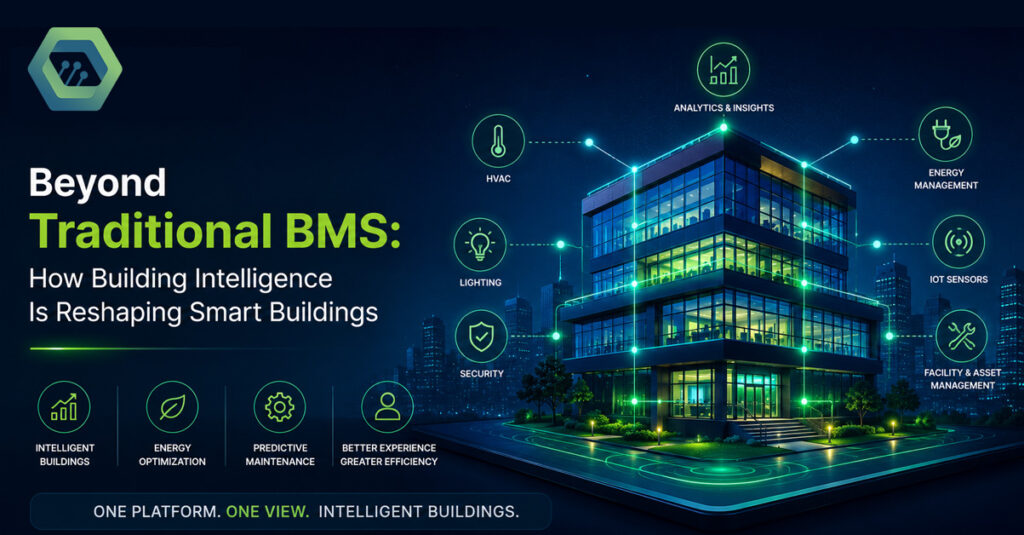
Buildings Are No Longer Just Automated—They’re Becoming Intelligent
For decades, Building Management Systems (BMS) have been the backbone of commercial buildings, controlling HVAC, lighting, elevators, and other critical infrastructure.
While traditional BMS platforms have improved operational efficiency, today’s buildings demand much more than automation.
Modern commercial buildings, hospitals, airports, campuses, hotels, industrial facilities, and mixed-use developments are evolving into intelligent ecosystems where every system, sensor, and asset contributes to real-time decision-making.
This shift has given rise to the Smart Building Platform—a unified digital layer that goes far beyond traditional Building Management Systems.
In 2026, organizations are no longer asking, “Can we automate our buildings?”
They’re asking:
“How can our buildings think, learn, and optimize themselves?”
What Is a Smart Building Platform?
A Smart Building Platform is an enterprise-wide digital platform that integrates building systems, IoT sensors, energy management, maintenance, occupancy analytics, and operational intelligence into a single ecosystem.
Unlike traditional BMS, which primarily controls equipment, a Smart Building Platform connects data across the entire building lifecycle.
A modern Smart Building Platform typically integrates:
- Building Management Systems (BMS)
- HVAC Systems
- Lighting Controls
- Energy Monitoring
- Water Management
- Fire & Life Safety
- Access Control
- CCTV & Security
- Elevators
- Indoor Air Quality Sensors
- Occupancy Sensors
- CAFM & CMMS
- IoT Devices
- AI Analytics
Instead of isolated automation, organizations gain centralized intelligence.
Why Traditional BMS Is No Longer Enough
Traditional Building Management Systems were designed primarily for automation.
They perform tasks such as:
- Temperature control
- HVAC scheduling
- Lighting automation
- Alarm management
- Equipment control
These capabilities remain important.
However, buildings today generate enormous volumes of operational data that extend beyond traditional BMS functionality.
Examples include:
- Occupancy patterns
- Energy usage
- Indoor environmental quality
- Asset performance
- Maintenance history
- Utility consumption
- Carbon emissions
- Workspace utilization
A traditional BMS cannot effectively correlate these datasets.
This is where a Smart Building Platform creates value.
From Building Automation to Building Intelligence
Automation executes predefined rules.
Intelligence continuously learns, analyzes, predicts, and optimizes.
For example:
A traditional BMS may switch HVAC on at 8:00 AM every day.
A Smart Building Platform evaluates:
- Real-time occupancy
- Outdoor weather
- Indoor temperature
- Energy pricing
- Historical usage
- Air quality
- Meeting schedules
Then automatically determines the most efficient operating strategy.
The result:
✔ Lower energy costs
✔ Improved occupant comfort
✔ Reduced carbon emissions
✔ Smarter operations
Key Capabilities of a Smart Building Platform
Centralized Building Visibility
Facility managers no longer need multiple dashboards.
A Smart Building Platform provides one interface to monitor:
- Mechanical Systems
- Electrical Infrastructure
- Utilities
- Security
- Maintenance
- Occupancy
- Sustainability KPIs
Every stakeholder works from a single source of truth.
IoT-Driven Building Intelligence
Thousands of IoT sensors continuously collect real-time data including:
- Temperature
- Humidity
- CO₂ Levels
- Occupancy
- Energy Consumption
- Water Usage
- Equipment Vibration
- Air Quality
Instead of simply displaying data, the platform converts it into actionable insights.
Predictive Maintenance
Reactive maintenance is expensive.
A Smart Building Platform identifies abnormal equipment behavior before failures occur.
Examples include:
- Chiller performance degradation
- HVAC motor anomalies
- Pump vibration
- Fan bearing wear
- Elevator health monitoring
Maintenance becomes proactive instead of reactive.
Intelligent Energy Optimization
Energy remains one of the largest operational costs for commercial buildings.
A Smart Building Platform continuously analyzes:
- HVAC efficiency
- Lighting demand
- Occupancy
- Peak energy consumption
- Renewable energy usage
Organizations reduce operational costs while achieving sustainability goals.
Occupancy-Based Automation
Hybrid workplaces have changed building operations.
A Smart Building Platform automatically adjusts:
- HVAC
- Lighting
- Ventilation
- Meeting room conditions
Based on actual occupancy rather than fixed schedules.
The result is significant energy savings without compromising occupant comfort.
Why Enterprises Are Investing in Smart Building Platforms
Lower Operational Costs
Integrated intelligence reduces energy waste, maintenance expenses, and manual intervention.
Improved Occupant Experience
Buildings become healthier, safer, and more comfortable.
Better indoor environments improve employee productivity and visitor satisfaction.
Sustainability & ESG Compliance
Organizations gain accurate reporting on:
- Energy consumption
- Carbon emissions
- Water usage
- Sustainability KPIs
Supporting corporate ESG initiatives.
Asset Lifecycle Management
Building assets operate longer through predictive maintenance and condition monitoring.
Capital expenditure is reduced.
Enterprise-Wide Visibility
Large organizations manage multiple facilities.
A Smart Building Platform provides centralized monitoring across:
- Office buildings
- Hospitals
- Campuses
- Airports
- Hotels
- Manufacturing facilities
Industry Applications
Commercial Real Estate
Monitor energy, occupancy, HVAC, lighting, and tenant comfort from one platform.
Healthcare
Ensure environmental compliance, asset reliability, and uninterrupted operations.
Universities & Smart Campuses
Connect classrooms, laboratories, utilities, and student facilities into one intelligent ecosystem.
Airports
Optimize passenger comfort, energy usage, baggage handling infrastructure, and facility operations.
Hotels
Improve guest experience while reducing operational costs through intelligent automation.
How AI Is Transforming Smart Building Platforms
Artificial Intelligence is redefining facility management.
AI analyzes:
- Equipment performance
- Occupancy trends
- Weather forecasts
- Utility consumption
- Historical maintenance
It can recommend or automate operational decisions, helping buildings become adaptive rather than reactive.
Examples include:
- Predictive HVAC optimization
- Dynamic lighting control
- Occupancy forecasting
- Energy anomaly detection
Why OmniWOT’s Smart Building Platform Is Different
OmniWOT extends beyond traditional building automation.
Its Smart Building Platform integrates:
Building Systems
- BMS
- HVAC
- Lighting
- Fire & Safety
- Access Control
- Elevators
IoT Infrastructure
Industrial-grade sensors continuously monitor:
- Temperature
- Humidity
- CO₂
- Air Quality
- Energy
- Water
- Equipment Health
Enterprise Systems
OmniWOT integrates seamlessly with:
- CAFM
- CMMS
- ERP
- Asset Management
- Energy Platforms
Edge-to-Cloud Architecture
Local control combined with enterprise-wide cloud analytics ensures real-time responsiveness and long-term scalability.
The Future of Smart Buildings
Buildings are evolving from passive infrastructure into intelligent digital assets.
The future belongs to buildings that can:
- Sense
- Learn
- Predict
- Optimize
- Automate
A Smart Building Platform becomes the intelligence layer that enables these capabilities.
It transforms buildings into living, connected ecosystems capable of improving operational efficiency, sustainability, and occupant experience simultaneously.
Frequently Asked Questions
What is a Smart Building Platform?
A Smart Building Platform integrates building systems, IoT sensors, maintenance, energy management, and analytics into a centralized operational platform.
How is a Smart Building Platform different from a traditional BMS?
Traditional BMS focuses on equipment control, while a Smart Building Platform provides enterprise-wide intelligence, predictive analytics, IoT integration, and business insights.
What are the benefits of a Smart Building Platform?
Benefits include lower energy costs, predictive maintenance, centralized visibility, improved occupant comfort, sustainability reporting, and operational efficiency.
Which buildings benefit from Smart Building Platforms?
Commercial offices, hospitals, airports, universities, hotels, industrial facilities, shopping malls, and smart campuses.
Can a Smart Building Platform integrate with an existing BMS?
Yes. Modern Smart Building Platforms like OmniWOT integrate with existing BMS infrastructure, protecting previous investments while adding intelligence and analytics.
Conclusion
Building automation has served organizations well for decades.
But automation alone is no longer enough.
Today’s enterprises require buildings that are intelligent, connected, predictive, and data-driven.
A Smart Building Platform bridges the gap between traditional BMS and the future of intelligent infrastructure by combining IoT, AI, analytics, energy optimization, predictive maintenance, and enterprise integration into a single operational ecosystem.
Organizations that embrace building intelligence today will define the next generation of smart, sustainable, and efficient facilities.