
The Manufacturing Landscape is Evolving Rapidly
Factories are investing heavily in advanced machinery, robotics, and automated production lines. Yet, despite these massive investments, many organizations still struggle with a fundamental roadblock: Fragmented operational data.
Is your factory running on disconnected machines, isolated PLCs, and siloed production dashboards? If your equipment cannot communicate seamlessly with your enterprise systems, your digital transformation journey is incomplete. Without a unified integration strategy, operational visibility remains restricted, decision-making slows down, and scaling your Smart Factory initiatives becomes complex and unnecessarily expensive.
At OmniWOT, we believe that smart factories aren’t built by replacing machines—they are built by connecting them.
The Hidden Cost of Disconnected Operations
A modern manufacturing facility relies on a mix of legacy equipment, multiple automation vendors, and diverse Operational Technology (OT) systems. The problem arises when these systems speak different languages.
When your data is disconnected, your organization experiences:
-
Operational Silos: Production data remains trapped inside individual SCADA systems or proprietary PLCs.
-
Delayed Decision-Making: Plant managers spend hours manually consolidating reports to understand daily output or OEE (Overall Equipment Effectiveness).
-
Reactive Problem Solving: Without real-time visibility, maintenance and production teams can only react to downtime after it occurs.
-
Complex IT/OT Alignment: Integrating shop-floor data with top-floor ERP systems becomes an expensive, point-to-point IT nightmare.
The Shift to a Unified Smart Factory Ecosystem
You do not need a complete hardware overhaul to digitize your operations. What you need is a robust integration layer.
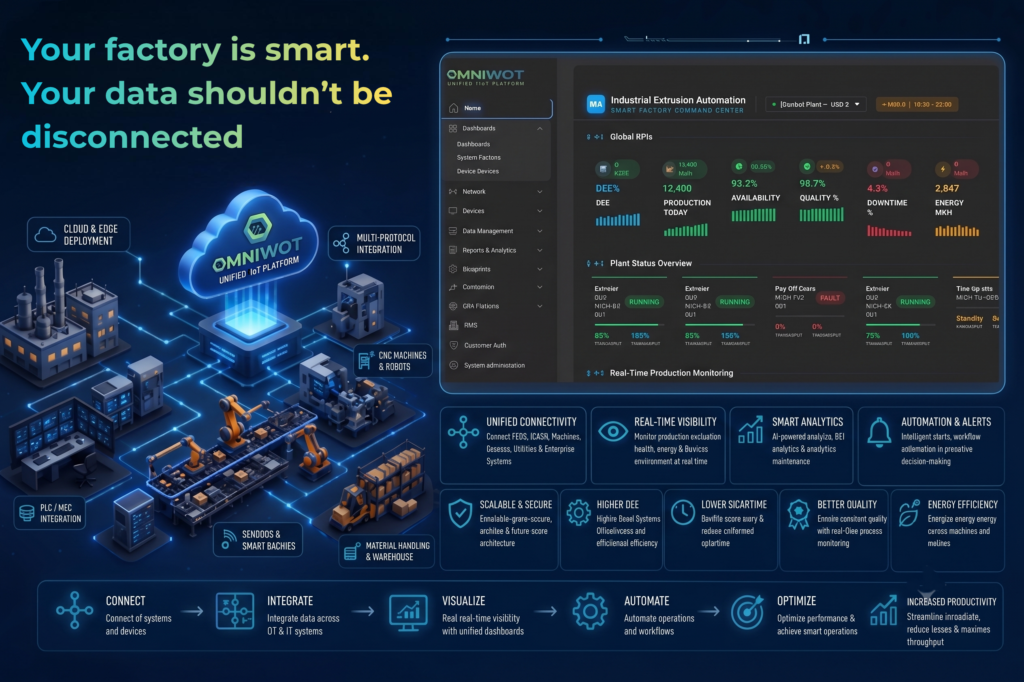
OmniWOT’s Unified Industrial IoT Platform bridges the gap between machines, PLCs, SCADA, sensors, utilities, and enterprise applications. Built on a vendor-neutral, edge-to-cloud architecture, we transform fragmented operations into a synchronized Smart Factory.
OmniWOT is Not Just a Dashboard—It’s an Integration Engine
Many manufacturers assume they need to buy new equipment to achieve Industry 4.0 maturity. OmniWOT proves otherwise. Our platform simplifies industrial integration without replacing your existing infrastructure.
Embedded Use Case 1:
Seamless Brownfield Modernization Most established factories operate on “brownfield” infrastructure—aging machines alongside modern automated lines.
-
With OmniWOT: Our multi-protocol integration engine speaks the language of your factory floor. We seamlessly connect Modbus, OPC UA, MQTT, and BACnet protocols, linking legacy Siemens or Allen-Bradley PLCs directly to the cloud.
-
Business Impact:
-
Upgrade legacy systems without massive capital expenditure.
-
Establish unified connectivity across CNC machines, material handling, and utilities.
-
Protect your previous automation investments.
-
Embedded Use Case 2: Real-Time Production & OEE Monitoring
Management teams need to see business metrics, while production teams need to see machine performance. Often, these views are disconnected.
-
With OmniWOT: Data flows directly from machines to a unified Smart Factory Command Center. Plant managers gain instant access to Global KPIs.
-
Business Impact:
-
Track Availability, Performance, and Quality in real time.
-
Instantly calculate and visualize accurate OEE percentages.
-
Automate workflows and receive intelligent alerts for downtime events before they escalate.
-
Why Leading Manufacturers Choose OmniWOT
Whether you are modernizing a single manufacturing plant or scaling across a multi-site enterprise, OmniWOT delivers measurable operational excellence.
Organizations partner with us to achieve:
-
Complete Operational Visibility: Monitor production execution, health, energy, and device environments in real time.
-
Universal Integration: Connect OT systems (PLCs, SCADA) directly with IT enterprise systems (MES, ERP).
-
Smart Analytics: Leverage AI-powered insights for predictive maintenance and energy optimization.
-
Scalable Architecture: Deploy securely via Edge or Cloud depending on your facility’s requirements.
Conclusion
A connected factory is a productive factory. The organizations leading the Industry 4.0 revolution are those that have successfully broken down data silos between their machines, processes, and enterprise systems.
Turn your fragmented operations into a connected ecosystem. Stop managing isolated dashboards and start optimizing your entire production line with real-time intelligence.
Discover how OmniWOT accelerates Smart Factory Digitization:
Frequently Asked Questions (FAQs)
1. What is Industrial Protocol Integration?
It is the process of translating different machine languages (like Modbus, OPC UA, or BACnet) into a single, unified data format so that diverse industrial equipment can communicate seamlessly.
2. Do I need to replace my legacy machines to use OmniWOT?
No. OmniWOT specializes in brownfield factory modernization. Our platform connects directly to your existing PLCs, SCADA systems, and legacy machinery without requiring you to replace your hardware.
3. How does OmniWOT improve OEE (Overall Equipment Effectiveness)?
By providing real-time visibility into machine availability, performance bottlenecks, and quality metrics, OmniWOT allows plant managers to instantly identify the root causes of downtime and optimize production flow.
4. Can OmniWOT integrate with our existing ERP or MES systems?
Yes. OmniWOT acts as a bridge between your operational technology (OT) and information technology (IT), ensuring seamless data flow from the shop floor directly to your ERP, MES, or CMMS applications.
5. Who is this platform built for?
OmniWOT’s Industrial Integration platform is engineered for Manufacturing Industries, Industrial Automation Companies, System Integrators, OEMs, Plant Managers, and Digital Transformation Consultants.