

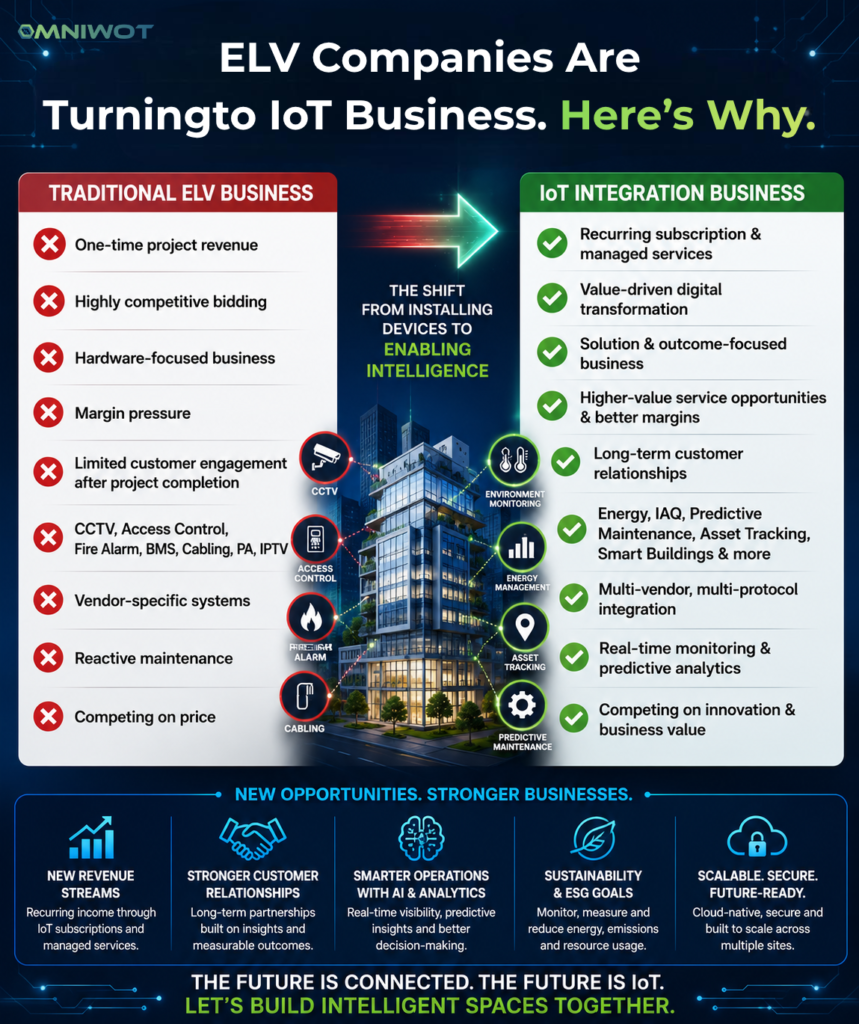
ELV Companies Are Turning to the IoT Business. Here’s Why.
The Changing Landscape of the ELV Industry
For decades, Extra-Low Voltage (ELV) System Integrators have served as the backbone of modern infrastructure. In the past, companies built strong businesses around core installations. These included CCTV, Access Control, Fire Alarms, Structured Cabling, Public Address systems, IPTV, and conventional Building Management Systems (BMS).
However, the commercial contracting space has shifted dramatically. Today, the traditional ELV sector faces intense commoditization. Because entry barriers are lower, rising competition has turned tenders into aggressive price wars.
Hardware margins are shrinking every year. In addition, revenue stops as soon as a project is handed over. As a result, contracting companies remain trapped in a cycle of bidding for one-time installations.
The Evolution from Hardware Contracting to Digital Value
Forward-thinking ELV companies recognize that sustainable growth requires an evolution. Therefore, established system integrators across the globe are rapidly expanding into Internet of Things (IoT) integration.
This transition is not happening because traditional systems are disappearing. Instead, enterprise clients are now demanding fundamentally different outcomes.
Today, building owners and facility managers want more than isolated hardware that passively records video. Specifically, they demand intelligent and connected ecosystems. These modern solutions help reduce utility costs, prevent equipment downtime, and deliver actionable operational intelligence.
Escaping the One-Time Revenue Trap
The primary catalyst driving contractors toward IoT is the shift in business models. In a conventional ELV project, the financial relationship is purely transactional and hardware-centric. Once the team pulls the cables and mounts the cameras, the project ends. Consequently, the integrator is left with low-margin, reactive maintenance work.
By incorporating an IoT platform like OmniWOT, system integrators can transform their revenue model. For instance, instead of competing only on hardware costs, integrators can package sensors, gateways, and cloud analytics into recurring managed services.
Selling real-time energy optimization, predictive fault detection, and automated climate control creates long-term value. Thus, the conversation shifts away from device pricing to true digital transformation.
A Natural Evolution, Not a Complete Reinvention
Fortunately, ELV companies do not need to start from scratch to enter the IoT space. The core skills required for IoT integration already exist within experienced ELV teams.
Your technicians already understand IP networking, structured wiring, controllers, and low-voltage automation. Moving into IoT integration simply means connecting those field devices to a centralized, cloud-based platform. Therefore, it serves as a natural extension of your existing capabilities.
Leading Tomorrow’s Smart Infrastructure
The future of smart facilities is not about installing more disconnected hardware. Rather, it is about connecting systems, analyzing data, and creating clear business value.
As the line between OT and IT continues to blur, traditional hardware contractors will face margin pressure. Conversely, companies that embrace IoT integration today will become trusted advisors for Smart Building, Smart Infrastructure, and Industry 4.0 projects.
The market has evolved. The future belongs to IoT System Integrators.
👉 Discover how OmniWOT empowers System Integrators and ELV Partners: https://omniwot.com/building-automation/