
The Fragmented Shop-Floor Dilemma
Walk through any modern manufacturing plant today, and you will witness a high degree of technical sophistication. Robotic arms weld with precision, and CNC machines execute complex milling cycles. Additionally, Programmable Logic Controllers (PLCs) govern high-speed assembly lines.
Yet, when you look behind the scenes at how operational data is managed, a frustrating reality emerges. The systems are still fundamentally disconnected.
Most manufacturing facilities operate as “brownfield” environments. This means they rely on a mix of twenty-year-old legacy equipment and modern automated machinery. For instance, you might run Siemens PLCs on one line and Allen-Bradley controllers on another. Meanwhile, standalone utility meters monitor plant power and water.
Because each vendor relies on proprietary software and communication languages, critical production data remains trapped in isolated silos. Consequently, plant managers spend hours manually exporting reports from different screens. As a result, calculating daily output or Overall Equipment Effectiveness (OEE) becomes a slow and tedious process.
Why Traditional Rip-and-Replace Approaches Fail
For years, manufacturers were told that Industry 4.0 required a complete, capital-intensive hardware overhaul. However, tearing out functioning legacy machinery simply to install smart equipment is disruptive and expensive. Therefore, this approach remains impractical for most industrial enterprises.
You do not need to replace your entire shop floor to build a synchronized Smart Factory. Instead, you need a robust, vendor-neutral integration layer. This layer bridges the gap between your physical assets and your enterprise applications.
OmniWOT: The Universal Translator for Industrial Operations
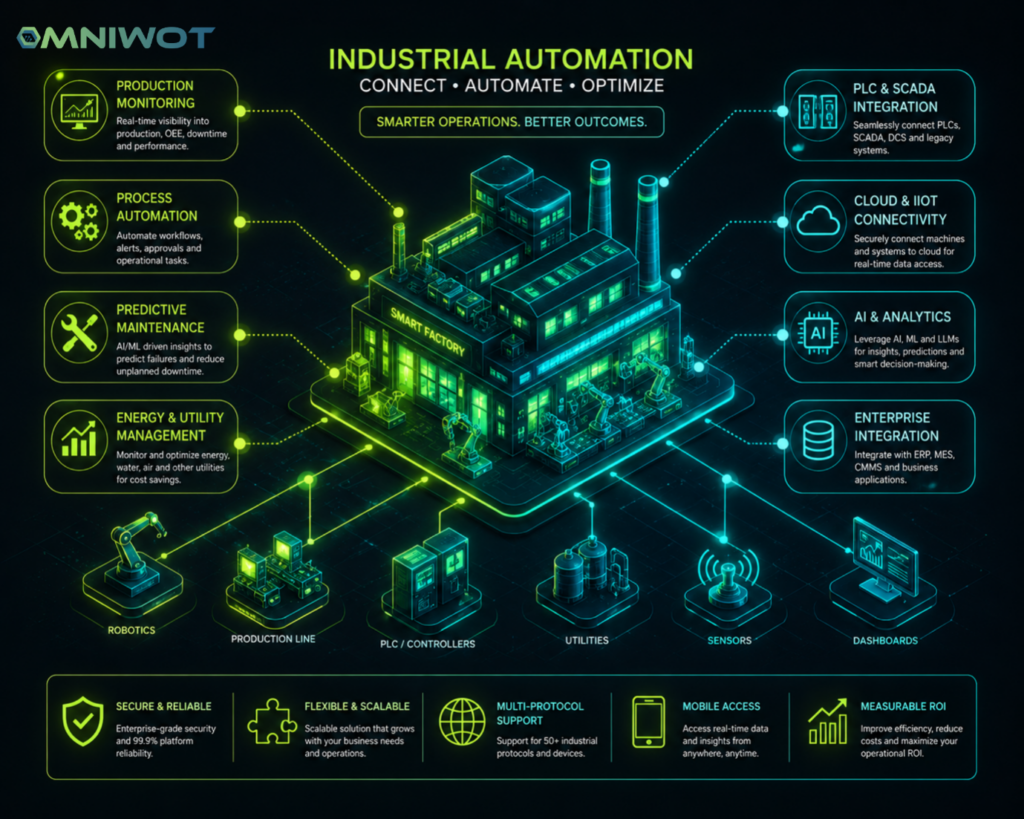
OmniWOT’s Unified Industrial IoT Platform is engineered to solve this connectivity challenge without disrupting your existing operations. Sitting at the intersection of Operational Technology (OT) and Information Technology (IT), our platform translates diverse machine languages into a single, unified operational truth.
Built on a flexible edge-to-cloud architecture, OmniWOT provides native support for industry-standard protocols, including:
-
OPC UA
-
Modbus
-
MQTT
-
BACnet
We connect directly to your legacy controllers, SCADA platforms, CNC machinery, and utility sensors. Therefore, the system normalizes raw shop-floor metrics and streams them directly into a centralized Smart Factory Command Center.
Transforming Raw Data into Actionable Manufacturing Intelligence
Connecting cables and protocols is only the foundation. The real transformation happens when unified data drives daily plant decisions. By integrating your manufacturing ecosystem through OmniWOT, your organization unlocks immediate operational advantages:
-
Real-Time OEE and Production Visibility: Eliminate estimated or manually calculated efficiency scores. The platform continuously tracks availability, performance throughput, and quality rates. As a result, plant leaders gain an accurate, second-by-second picture of line productivity.
-
Seamless IT-OT Enterprise Synchronization: Production output, energy consumption, and equipment health metrics flow automatically from shop-floor machines into ERP, MES, and CMMS systems. Consequently, this synchronization eliminates manual data entry errors and improves supply chain forecasting.
-
Proactive Bottleneck and Downtime Prevention: When your entire plant floor is visible on a single pane of glass, production bottlenecks and minor equipment anomalies become instantly apparent. Therefore, teams can address process deviations before they cascade into unplanned stoppages.
-
Unified Utility and Energy Monitoring: True operational efficiency requires correlating production output with utility consumption. By integrating power, water, and compressed air metrics alongside machine data, plant managers can identify energy-intensive cycles. This helps teams optimize resource efficiency per unit produced.
Future-Proofing Your Manufacturing Enterprise
Digital transformation should extend the lifespan and value of your existing investments, not make them obsolete. By deploying a hardware-agnostic integration platform, you turn aging machinery into connected, intelligent assets. These assets can support AI-driven analytics, predictive maintenance, and digital twin initiatives.
Whether you are an automation engineer optimizing a single line or a plant manager overseeing a large factory, your data is your most valuable asset. Do not let it remain trapped in disconnected machines. When your shop floor and enterprise systems finally work in harmony, your factory runs smarter, faster, and significantly more competitively.
👉 Discover how OmniWOT accelerates Smart Factory Digitization:
#SmartFactory #Industry40 #IndustrialIoT #IIoT #FactoryAutomation #ITOTConvergence #OperationalIntelligence #OEE #ManufacturingEfficiency #OmniWOT