
Your Factory Is Automated. So Why Is It Still Disconnected? 🏭
Ask any Engineering Manager:
“Can you get production, machine, energy and maintenance data from your entire factory in one place?”
The answer is often: Yes… but not that easily.
-
The PLC has the data.
-
The SCADA has the data.
-
The CNC machine has the data.
-
The energy meter has the data.
And someone is still maintaining an Excel sheet.
That is the real Industrial Automation problem. The factory isn’t lacking automation. It’s lacking integration.
The Integration Challenge
The machines don’t need to change. The way they communicate does.
A typical plant may have: Siemens PLCs + Allen-Bradley PLCs + CNC machines + VFDs + SCADA + energy meters + robots + HVAC + legacy equipment
And they may all speak different languages: OPC UA • Modbus • MQTT • BACnet • Ethernet/IP • Profinet • Legacy Interfaces
Replacing perfectly working equipment just to make everything “Industry 4.0 ready” is rarely practical.
So the engineering question becomes:
“How do I connect all this without disturbing my existing automation?”
This Is Where OmniWOT Fits
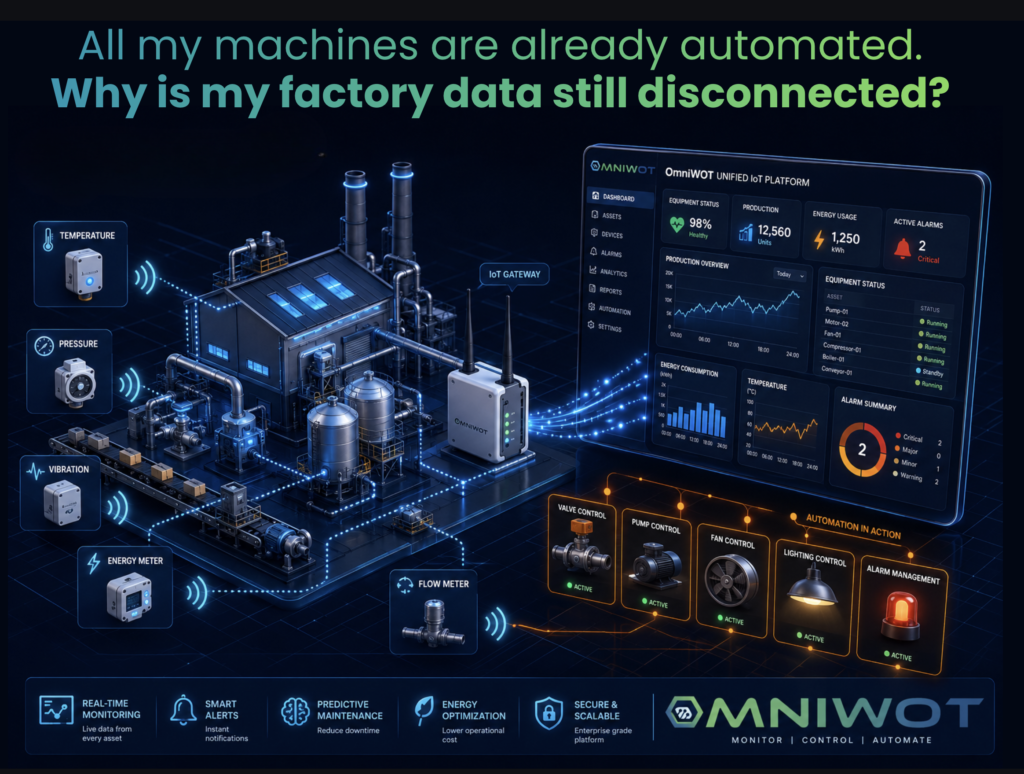
OmniWOT provides a unified Industrial IoT integration layer between your existing factory equipment and modern applications.
-
Existing machines stay.
-
Existing PLCs stay.
-
Existing SCADA stays.
-
Existing automation stays.
OmniWOT connects the data.
What Can You Bring Together?
-
PLC & Controllers: Siemens, Allen-Bradley and other industrial controllers.
-
SCADA, DCS & RTUs: Bring operational data beyond individual control systems.
-
CNC Machines & Industrial Robots: Monitor machine status, production parameters, runtime and downtime.
-
VFDs, Energy Meters & Utilities: Correlate machine operation with energy and utility consumption.
-
Legacy Equipment: Modernize brownfield plants without automatically replacing working machinery.
Turning Data Into Action
Collecting data is not the end goal. This is where many IoT projects stop.
OmniWOT takes it further. Machine data can be transformed into information engineering and production teams can actually use:
Machine Status → Runtime → Downtime → Production → Energy → OEE → Action
Now you can start asking better questions:
-
Which machine is actually causing production loss?
-
Where is unplanned downtime increasing?
-
Which machines are consuming more energy than expected?
-
Is the problem with the machine, process or operator?
-
What is the actual Availability, Performance and Quality?
-
Can production and maintenance see the same real-time information?
-
Can machine data flow into MES, ERP or CMMS instead of being manually re-entered?
One Factory. One Operational View.
Instead of: Machine → PLC → SCADA → Separate Dashboard → Excel → Management
You can build: Machines & Equipment → OmniWOT → Unified Industrial IoT Platform → OEE • Analytics • Dashboards • MES • ERP • CMMS
That is the difference between having automated machines and having a connected factory.
And this is the part most factories miss: Industry 4.0 doesn’t always mean replacing your factory. Sometimes, it means connecting the factory you already have.
-
Your PLC doesn’t need another dashboard.
-
Your CNC doesn’t need another isolated system.
-
Your Engineering Manager doesn’t need another Excel report.
Your factory needs its systems to start talking to each other.
OmniWOT Industrial Automation & Integration Connect. Integrate. Monitor. Analyze. Act. From PLC to Cloud. | From Machine to Management. | From OT to IT.
👉 Explore OmniWOT Industrial Automation & Integration: https://omniwot.com/industrial-automation-industry-4-0-platform-smart-factory-industrial-iot-solutions-omniwot/
#IndustrialAutomation #IndustrialIntegration #IndustrialIoT #SmartFactory #Industry40 #FactoryAutomation #PLC #SCADA #OPCUA #Modbus #MQTT #CNC #OEE #SmartManufacturing #BrownfieldAutomation #OTIT #DigitalTransformation #OmniWOT