
Introduction: Why Traditional BMS Is No Longer Enough
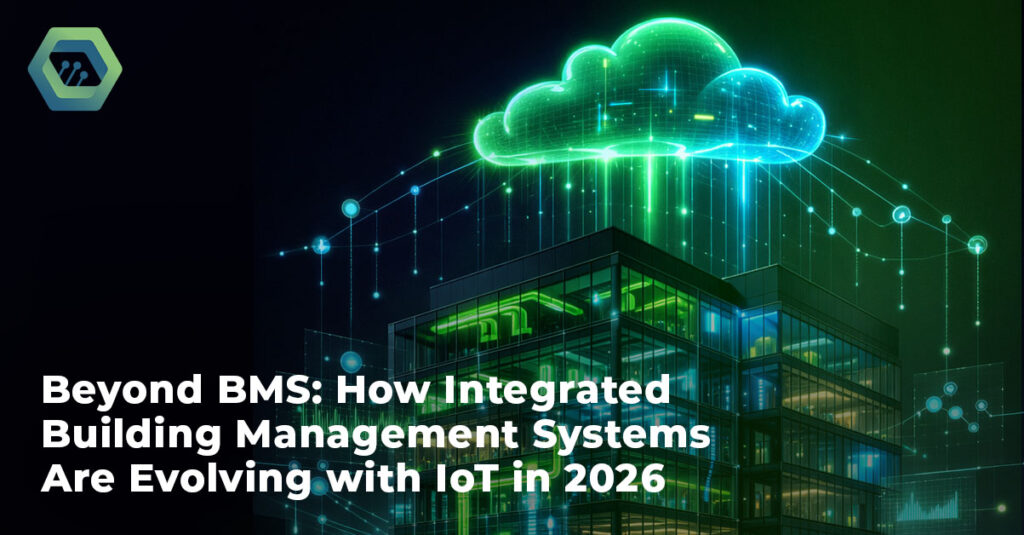
For years, Building Management Systems (BMS) have helped facilities monitor HVAC, lighting, power systems, and safety infrastructure. But in 2026, traditional BMS alone cannot meet the growing demands of energy optimization, sustainability compliance, and real-time decision-making.
Modern buildings are no longer just physical structures. They are intelligent ecosystems requiring continuous monitoring, predictive analytics, and centralized control. This is where Integrated Building Management Systems (IBMS) powered by IoT platforms are transforming the industry.
What Is an Integrated Building Management System (IBMS)?
An Integrated Building Management System connects multiple building subsystems into a unified platform, including:
- HVAC systems
- Energy monitoring
- Lighting control
- UPS monitoring
- Water management
- Occupant comfort tracking
- Air quality monitoring
Instead of operating in silos, these systems communicate through a centralized IoT platform that provides real-time insights and automation.
In 2026, IBMS is no longer optional—it is essential for operational efficiency and sustainability.
The Shift: From Monitoring to Intelligence
Traditional BMS focuses on monitoring.
Modern IBMS with IoT focuses on intelligence.
1️⃣ Real-Time Visibility Across Facilities
IoT-enabled IBMS allows facility managers to monitor multiple buildings from a single dashboard. Whether it’s temperature fluctuations, energy spikes, or water leakage, alerts are instant.
2️⃣ Predictive Maintenance
Sensors connected through LoRaWAN and multi-protocol gateways detect anomalies before failures occur—reducing downtime and maintenance costs.
3️⃣ Energy Optimization & ESG Compliance
Energy costs are rising, and sustainability regulations are tightening. IoT-driven IBMS enables:
- Energy consumption tracking
- Carbon footprint monitoring
- Automated load balancing
- Demand-based HVAC control
This directly impacts cost savings and environmental performance.
Why IoT Is the Game Changer in 2026
Integrated Building Management Systems are evolving due to three major IoT advancements:
🔹 Multi-Protocol Integration
Modern buildings contain legacy systems using BACnet, Modbus, CAN bus, and newer LoRaWAN devices.
An advanced IoT platform integrates all of them without replacing infrastructure.
🔹 Cloud-Based Centralization
Cloud-native platforms allow centralized building operations across campuses, cities, and regions—securely and in real time.
🔹 Data-Driven Decision Making
With AI-ready dashboards and digital twin visualization, facility teams move from reactive management to proactive optimization.
Key Benefits of IoT-Driven IBMS
✅ Reduced Operational Costs
Unified monitoring reduces energy waste and manual intervention.
✅ Improved Occupant Comfort
Temperature, air quality, and lighting adjust automatically based on occupancy data.
✅ Faster Response Time
Real-time alerts prevent small issues from becoming expensive failures.
✅ Scalability Without Rewiring
LoRaWAN sensors enable retrofitting without tearing down ceilings or replacing entire systems.
✅ Single Dashboard Control
No more disconnected software systems. Everything runs through one intelligent platform.
Real-World Applications
Integrated Building Management with IoT is ideal for:
- Commercial complexes
- Smart campuses
- Hospitals
- Manufacturing plants
- Airports
- Government infrastructure
In each case, the goal remains the same:
Centralized control, energy efficiency, safety, and sustainability.
The Future of Building Automation
In 2026, the most competitive facilities will not just manage buildings—they will optimize them.
Integrated Building Management Systems powered by IoT platforms will enable:
- Digital twins of facilities
- AI-driven energy forecasting
- Automated compliance reporting
- Smart grid interaction
- Predictive asset health monitoring
The future is not about replacing existing systems.
It’s about intelligently connecting them.
Conclusion
Traditional BMS systems laid the foundation for automation.
But in 2026, Integrated Building Management Systems powered by IoT are redefining smart infrastructure.
Organizations that adopt unified, scalable, and secure IoT-driven IBMS solutions will gain:
- Lower energy costs
- Higher operational efficiency
- Better occupant satisfaction
- Stronger sustainability performance
The evolution beyond BMS has already begun.