
The Indian connectivity crisis
Industry 4.0 promises dramatic gains in efficiency, automation and real-time decision making. Yet many Indian manufacturers, utilities and smart-building projects are held back by a less glamorous but fundamental problem: the Protocol Wars. Legacy wired OT (Modbus, BACnet, CAN bus) lives side-by-side with modern wireless sensors (LoRaWAN, BLE), and they don’t speak the same language. The result is costly data silos, risky security gaps and stalled ROI.
For CTOs and facilities leaders the question is no longer if to adopt IIoT — it’s how to build a secure, scalable hybrid architecture that unifies these disparate protocols and delivers measurable business value.
Why India needs a Hybrid Connectivity Strategy now
Three India-specific pressures make hybrid IIoT essential:
- Legacy lock-in. Large installed bases of PLCs, VFDs and BMS equipment run older protocols like Modbus and BACnet. Replacing them is expensive and disruptive.
- Infrastructure volatility. Many sites operate with intermittent networks or limited cellular coverage. Solutions must tolerate connectivity gaps.
- Cost vs TCO tradeoffs. Low-cost IoT modules can create long-term reliability and security headaches; smart architectural choices reduce total cost of ownership.
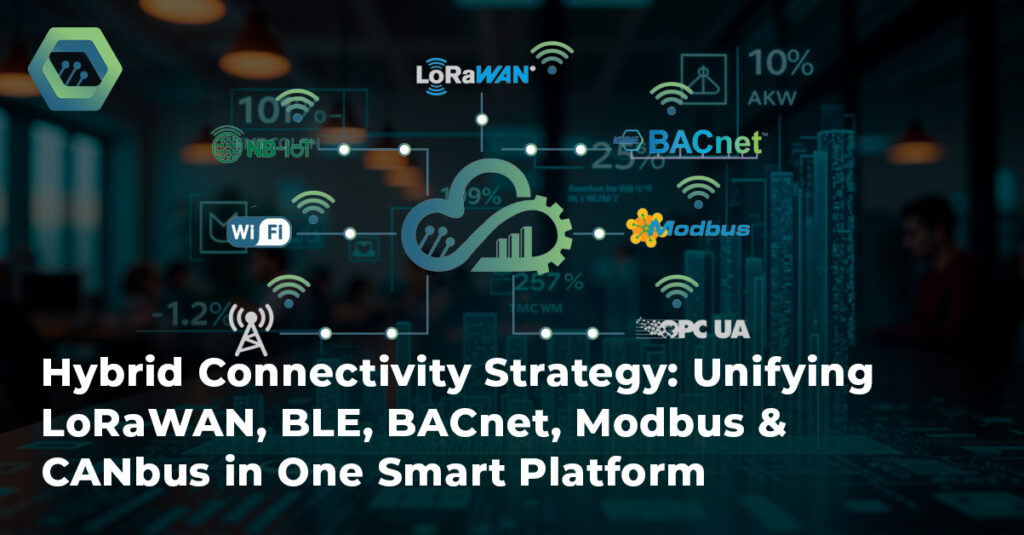
A well-designed hybrid approach — combining long-range LoRaWAN, short-range BLE, wired Modbus/CAN and BACnet for buildings — is the only practical path to scaleable, secure IIoT that pays back.
The five pillars — role, conflict and semantic consistency
Successful hybrid IIoT depends on understanding each protocol’s role and constraints.
Protocol roles at a glance
| Protocol | Primary function | Typical India use case | Integration challenge |
|---|---|---|---|
| LoRaWAN | Long-range, battery-efficient mMTC | Utility metering, wide-area asset tracking, campus sensors | Translating wide-area data into localized systems |
| BACnet | Building automation standard, semantically rich | HVAC, lighting, BMS in smart buildings | Scaling BACnet to include thousands of wireless sensors |
| Modbus | Legacy industrial control | PLCs, meters, VFDs on factory floors | Lacks semantic ontology — raw registers need interpretation |
| CAN bus | High-speed embedded control | Vehicle & machine networks (mining, material handling) | Requires high-speed interfaces & packet decoding |
| BLE | Short-range interaction & commissioning | Wearables, indoor tracking, device commissioning | Local aggregation & gateway handoff required |
The semantic gap: Modbus vs BACnet
The core technical problem is often semantic, not physical. Modbus returns raw register values (e.g., 40001 = 500) that require external mapping to meaningful metrics (pump pressure = 500 kPa). BACnet, by contrast, carries self-describing objects (a temperature value is labeled as °C). A hybrid platform must act as a “meaning engine”, normalizing Modbus/CAN raw data into semantic objects (UNS/BACnet objects) so modern analytics and dashboards can consume data without constant manual mapping.
The unified architecture: Edge gateway + Unified Namespace (UNS)
1) Multi-protocol edge gateway — the unification engine
At the edge you need an industrial, multi-protocol gateway that can:
- Aggregate wireless LoRaWAN messages from thousands of sensors.
- Act as a Modbus master (RS485/TCP) and read PLC/VFD registers.
- Interface with CAN bus networks for high-speed telemetry.
- Accept BLE devices for local commissioning and wearables.
- Run local logic: buffering, filtering, rules, offline operation and secure backhaul (4G/ethernet).
This gateway is not a dumb pipe — it’s the first layer of normalization and security.
2) The Unified Namespace (UNS) — semantic convergence
UNS is the architectural glue: a unified, semantically consistent data model that presents every data point — whether from LoRaWAN, Modbus, BACnet or CAN — as standardized, analytics-ready objects.
Benefits:
- Eliminates manual register mapping and documentation overhead.
- Accelerates AI/DL ingestion (data is “ready to consume”).
- Removes the “ANALYZE LATER” bottleneck by providing consistent real-time data across systems.
Real-world use cases & measurable ROI in India
Smart building retrofits (LoRaWAN + BACnet)
Challenge: retrofit room-level sensors across large commercial buildings without rewiring.
Solution: LoRaWAN sensors deliver long battery life and deep indoor reach. The gateway converts sensor data into BACnet objects for existing BMS dashboards.
ROI: Real deployments show 10–30% HVAC savings via demand-controlled ventilation and microclimate optimization — with minimal disruption.
Predictive maintenance & OEE (Modbus + CAN + LoRaWAN)
Challenge: combine vibration and temperature sensors with PLC telemetry to predict failures.
Solution: Combine wireless vibration (LoRa/BLE) with Modbus/CAN process data in the UNS. AI models detect anomalies earlier.
ROI: Predictive maintenance programs can reduce unplanned downtime by up to 40%, translating into major cost avoidance and productivity gains.
Smart energy management
Combine LoRaWAN utility metering with process data to locate energy wastage. Integrated dashboards enable 15–25% energy reductions in targeted processes and smoother integration of onsite renewables.
Security and resilience: architecture that reduces operational risk
Connecting legacy OT to IP networks introduces cyber risk. A hybrid platform must adopt security-by-design:
Edge security barrier
- Secure Boot and TPM on gateways
- Strong encryption for edge-to-cloud transport
- Network segmentation to isolate vulnerable OT devices
- Local buffering and rules to continue safe operation during outages
Scalability & reliability
- LoRaWAN for device density and long battery life
- Flattened BACnet models to avoid BMS overload when adding thousands of sensors
- Edge processing ensures productivity even when backhaul is degraded
Security & scalability checklist (India focus)
| Challenge | Platform feature | KPI/value |
|---|---|---|
| Legacy vulnerability | Secure edge gateway (encryption & secure boot) | Prevents lateral attacks |
| Connectivity gaps | Local buffering & 4G/LTE backhaul | Maintains operations during downtime |
| Data silos | Unified Namespace | Real-time, analytics-ready data |
| Device density | LoRaWAN & flattened BACnet | Supports thousands of endpoints |
| Modbus complexity | Automated semantic mapping | Cuts commissioning time & errors |
Implementation roadmap — practical steps for Indian projects
- Assess: inventory legacy devices, networks, and risk exposure.
- Pilot: deploy multi-protocol gateways on a line or building and onboard 50–200 devices.
- UNS mapping: define object models for key assets (pumps, motors, HVAC zones).
- Analytics & rules: deploy basic anomaly detection and automation rules (no-code/low-code).
- Scale: flatten BACnet views, add LoRaWAN nodes, expand predictive models.
- Security hardening: isolate OT segments, enable encryption & secure updates.
- Measure ROI: track OEE, downtime, energy KPIs and TCO.
The business case — quantified benefits
- Downtime reduction: up to 40% via predictive maintenance.
- HVAC / energy savings: 10–30% via occupancy and microclimate control.
- Lower commissioning cost: automated semantic mapping and UNS reduces manual integration time.
- Lower TCO: preserve legacy investments and add wireless sensors without ripping out infrastructure.