

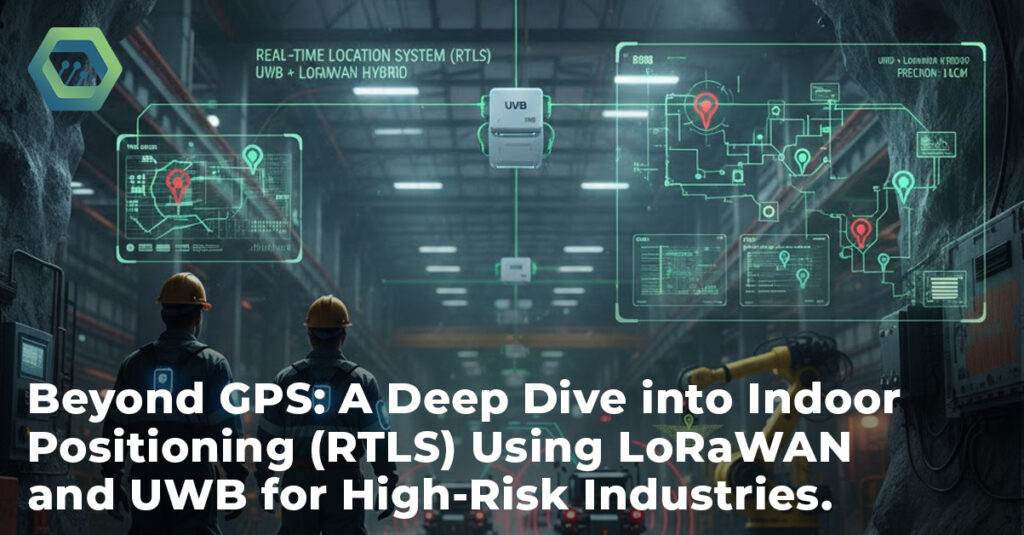
In the vast, steel-laden corridors of a manufacturing plant or the subterranean tunnels of a deep-shaft mine, the Global Positioning System (GPS) is effectively blind. For high-risk industries, this “blind spot” isn’t just an operational nuisance—it’s a critical safety risk.
As we move through 2026, the industry is moving Beyond GPS. The convergence of LoRaWAN and Ultra-Wideband (UWB) is creating a new gold standard for Real-Time Location Systems (RTLS), providing the precision of a surgical strike with the long-range reliability of a lighthouse.
The GPS Failure: Why Indoor Positioning is Different
GPS relies on line-of-sight signals from satellites. In “harsh” environments—characterized by thick concrete, metal shielding, and underground depths—these signals are absorbed or reflected, leading to errors of hundreds of meters, or total signal loss.
For high-risk sectors like Mining, Oil & Gas, and Heavy Manufacturing, knowing a worker is “somewhere in the facility” isn’t enough. You need to know if they are within 10 centimeters of a high-voltage zone or a moving automated guided vehicle (AGV).
The Power Duo: UWB Accuracy + LoRaWAN Connectivity
To solve the indoor challenge, engineers have turned to a hybrid architecture that uses two distinct radio technologies:
1. Ultra-Wideband (UWB) for Precision
UWB is the “microscope” of positioning. By sending nanosecond pulses across a wide frequency spectrum, it calculates location based on Time of Flight (ToF) rather than signal strength.
- Accuracy: Centimeter-level (typically 10–30 cm).
- Resilience: Virtually immune to multi-path interference (signals bouncing off metal walls).
- Use Case: Proximity alerts, collision avoidance, and tool-level tracking.
2. LoRaWAN for the Backhaul
If UWB provides the data, LoRaWAN is the highway that carries it. Instead of wiring every UWB anchor to an Ethernet port (which is impossible in a 2km-deep mine), LoRaWAN acts as a low-power wireless backhaul.
- Range: Covers kilometers with a single gateway.
- Power: Allows battery-powered anchors to last for years.
- Use Case: Transmitting location “heartbeats” and SOS alerts to the central command center.
RTLS in Action: High-Risk Use Cases
🛠️ Manufacturing: The Digital Twin
In 2026, “Smart Factories” use UWB to track assets in real-time. If a specialized torque wrench leaves its designated station, the system logs it. If an employee enters a “no-go” zone near a robotic arm, the arm automatically slows or stops.
Result: A 40% reduction in workplace accidents and a massive boost in assembly line efficiency.
⛏️ Underground Mining: The Safety Lifeline
Mining environments are the ultimate test for IoT. By deploying LoRaWAN-connected UWB anchors in tunnels, mine managers can achieve Emergency Mustering in minutes rather than hours. In the event of a cave-in or gas leak, rescuers know the exact coordinates of every individual underground.
🛢️ Oil & Gas: Hazardous Zone Management
In refineries, “Lone Worker” protection is paramount. Wearable UWB badges can detect a fall (via integrated accelerometers) and broadcast the precise floor and room location via LoRaWAN, even through dense steel piping that kills Wi-Fi signals.
Comparison: RTLS Technologies at a Glance
| Technology | Accuracy | Range | Battery Life | Best For |
| GPS | 5–10m | Global (Outdoor) | High Drain | Logistics, Outdoor Fleets |
| Wi-Fi | 5–15m | Short | Very High Drain | General Office Assets |
| BLE (Bluetooth) | 1–3m | Medium | Low Drain | Retail, Zone-based Tracking |
| UWB + LoRaWAN | 10–30cm | Long (Hybrid) | Ultra-Low | High-Risk Safety, AGVs |
Implementing the Hybrid Model: A 2026 Roadmap
Deploying a hybrid RTLS isn’t just about the hardware; it’s about the integration.
- Anchor Placement: UWB anchors are placed in high-precision zones (entry/exit points, hazardous machinery).
- LoRaWAN Gateway: A central gateway is installed to collect data from the entire site.
- Edge Processing: Data is filtered at the gateway level to ensure only critical location changes are sent to the cloud, saving bandwidth.
Conclusion: Accuracy Saves Lives
The transition from “presence detection” to “precise positioning” is the biggest leap in industrial safety this decade. By combining the surgical precision of UWB with the industrial-grade reach of LoRaWAN, high-risk industries are finally eliminating the “black holes” in their operational visibility.