

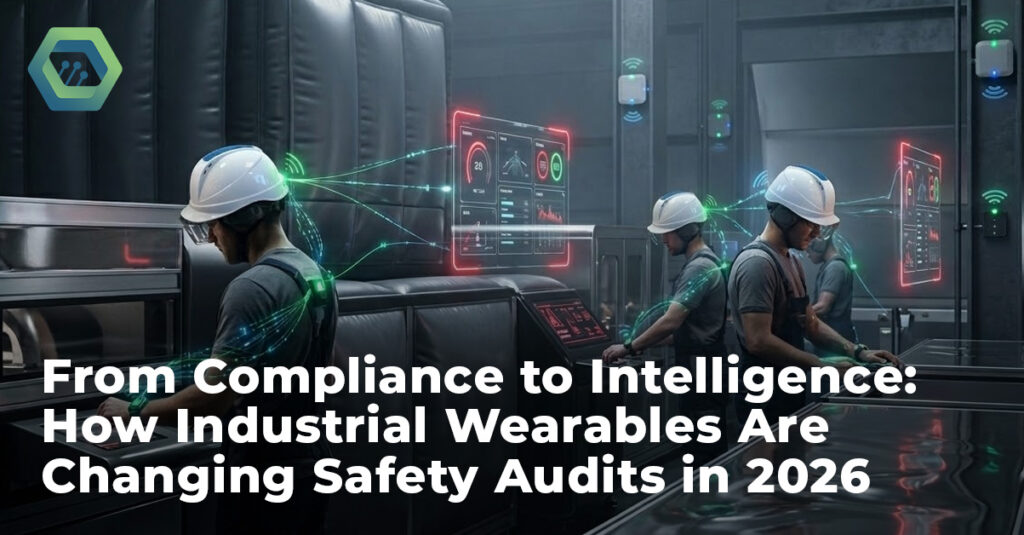
Introduction: Safety Audits Are No Longer Enough
For decades, workplace safety relied heavily on manual audits, periodic inspections, and compliance documentation.
Supervisors would walk through factory floors with checklists, ensuring workers followed safety protocols.
But traditional safety audits have major limitations:
• They are periodic, not continuous
• They rely on human observation
• Risks are often detected after incidents occur
In 2026, industries are shifting from compliance-driven safety to intelligence-driven safety.
The catalyst for this transformation is industrial wearables powered by IoT.
Smart helmets, connected watches, and sensor-enabled wearables are turning workers themselves into real-time safety data points.
What Are Industrial Wearables?
Industrial wearables are sensor-equipped devices worn by workers to monitor safety conditions, environmental risks, and worker health in real time.
Examples include:
- Smart safety helmets
- Industrial smart watches
- Wearable gas detectors
- Location tracking tags
- Environmental monitoring badges
These devices connect to IoT platforms and RTLS systems, providing continuous visibility into workplace safety conditions.
OmniWOT integrates these wearables into its IoT Cloud Platform, enabling centralized monitoring and analytics.
The Limitations of Traditional Safety Audits
Traditional safety audits focus on compliance.
Auditors check whether workers are:
- Wearing PPE
- Following safety procedures
- Operating equipment correctly
However, these checks occur only during inspections.
Critical incidents can occur between audits, such as:
• Worker fatigue
• Exposure to hazardous gases
• Falls or impacts
• Entry into restricted zones
Industrial wearables eliminate this gap by enabling continuous safety monitoring.
How Industrial Wearables Are Transforming Safety Audits
1. Real-Time Worker Monitoring
Smart helmets and watches can monitor:
- Heart rate
- Worker activity
- Environmental conditions
- Motion and impact detection
If abnormal patterns occur, alerts are triggered instantly.
For example:
A worker exposed to extreme heat or fatigue can trigger an automated safety alert.
2. Automatic Incident Detection
Industrial wearables detect:
• Falls
• Impacts
• Helmet removal
• Worker inactivity
These alerts are immediately sent to supervisors through the OmniWOT IoT dashboard.
This dramatically reduces response times during emergencies.
3. Location-Based Safety Monitoring
By integrating RTLS and IoT location tracking, wearables can monitor worker movement across industrial facilities.
Applications include:
- Restricted area detection
- Lone worker protection
- Hazard zone alerts
- Evacuation tracking
This creates a digital safety map of the entire facility.
4. Environmental Hazard Monitoring
Modern wearables include sensors that detect:
- Temperature
- Humidity
- Gas exposure
- Noise levels
- Air quality
This helps organizations identify environmental risks before they cause incidents.
OmniWOT Wearables for Industrial Safety
OmniWOT provides advanced wearable IoT solutions for industrial safety.
Smart Safety Helmet
Features include:
• Fall detection
• Helmet removal alerts
• High-voltage proximity warning
• Environmental monitoring
• SOS emergency alerts
These capabilities help organizations reduce workplace accidents and improve worker safety.
Smart Industrial Watch
Connected watches enable:
• Worker health monitoring
• Real-time alerts
• Location tracking
• Emergency communication
Combined with the OmniWOT IoT platform, these wearables create a connected workforce safety ecosystem.
The Role of IoT Platforms in Wearable Safety
Industrial wearables generate large volumes of real-time data.
Without a unified platform, this data remains underutilized.
The OmniWOT IoT Platform enables:
- Centralized monitoring dashboards
- Real-time safety alerts
- Worker location tracking
- Historical safety analytics
- Predictive risk detection
This turns raw sensor data into actionable safety intelligence.
Real Benefits for Industrial Organizations
Organizations deploying industrial wearables report measurable improvements.
Improved Worker Safety
Continuous monitoring helps prevent accidents.
Faster Emergency Response
Instant alerts enable faster incident response.
Better Compliance Reporting
Digital records simplify regulatory audits.
Predictive Safety Insights
Data analytics help identify patterns and prevent incidents.
Reduced Insurance Risks
Improved safety records reduce operational risk.
Industrial Wearables in High-Risk Industries
Wearable IoT technology is widely used in:
Manufacturing
Monitoring worker movement and machine safety.
Construction
Fall detection and location tracking.
Oil & Gas
Gas exposure monitoring and worker safety.
Utilities
High-voltage proximity alerts.
Smart Campuses
Personnel safety monitoring across large facilities.
The Future of Worker Safety
The future of workplace safety will combine:
• Industrial wearables
• IoT platforms
• AI-driven analytics
• RTLS location intelligence
This will enable predictive safety systems capable of preventing accidents before they occur.
Instead of reacting to incidents, organizations will anticipate and prevent them.
Conclusion
Safety audits will always remain important.
But in 2026, they are no longer enough.
Industrial wearables provide continuous safety intelligence, transforming workplaces from reactive safety environments to proactive safety ecosystems.
With solutions like OmniWOT Smart Helmets, Smart Watches, and IoT platforms, organizations can build safer, smarter, and more resilient workplaces.
The future of worker safety is connected, intelligent, and real-time.