
Why Connected Systems Alone Don’t Create Business Value
Organizations across industries are investing heavily in digital transformation.
Factories deploy Industrial IoT sensors.
Buildings install smart automation systems.
Utilities implement advanced monitoring infrastructure.
Logistics companies digitize fleets and warehouse operations.
Yet despite these investments, many organizations continue to struggle with the same challenge:
They have data everywhere but intelligence nowhere.
The reason is simple.
Connectivity alone is not enough.
Data becomes valuable only when it is placed into context.
This is where true integration creates business impact.
Connectivity Tells You What Happened
Context Tells You Why It Happened
Most digital transformation initiatives begin with connecting devices.
Machines become connected.
Sensors start transmitting data.
Dashboards begin displaying information.
At first, this appears to be progress.
However, organizations soon discover a new challenge.
They now have:
• Machine data
• Energy data
• Production data
• Maintenance data
• Utility data
• Environmental data
But each dataset still exists independently.
The result is isolated visibility.
You can see information.
But you cannot understand relationships.
And without relationships, there is no operational intelligence.
Before Integration: A Fragmented View of Operations
Many organizations operate with disconnected systems.
Manufacturing
Production teams monitor machine performance.
Maintenance teams manage work orders.
Energy teams track utility consumption.
Each team sees only part of the picture.
Smart Buildings
BMS monitors HVAC systems.
Energy platforms monitor consumption.
Occupancy systems track building usage.
Each platform operates independently.
Logistics
Fleet management tracks vehicles.
Fuel systems monitor consumption.
Driver performance is measured separately.
Critical operational insights remain hidden between systems.
The outcome is familiar:
❌ Delayed decision-making
❌ Operational blind spots
❌ Missed optimization opportunities
❌ Increased costs
❌ Reactive management
After Integration: Data Gains Context
True integration creates something far more valuable than connectivity.
It creates correlation.
Instead of isolated data points, organizations gain operational understanding.
Production vs Energy Consumption
Why did energy usage increase while production output remained flat?
Downtime vs Equipment Performance
Which machine conditions contribute most to unplanned downtime?
Occupancy vs HVAC Consumption
Why are energy costs rising despite lower building occupancy?
Fleet Activity vs Fuel Consumption
Which routes, drivers, or operating conditions create excessive fuel usage?
These questions cannot be answered through connectivity alone.
They require integrated intelligence.
What Integration Actually Enables
Integration transforms isolated data into contextual intelligence.
Organizations gain the ability to understand:
Cause and Effect
Not just what happened—but why it happened.
Root Cause Visibility
Identify relationships between systems that would otherwise remain hidden.
Cross-Functional Intelligence
Operations, maintenance, energy, finance, and management teams work from a shared source of truth.
Faster Decision-Making
Insights become actionable because context is immediately available.
The result is operational clarity.
And operational clarity creates competitive advantage.
Manufacturing: OEE Optimization Through Data Correlation
Manufacturers often focus on machine monitoring.
But machine monitoring alone does not improve Overall Equipment Effectiveness (OEE).
The real value comes from understanding relationships.
With OmniWOT integration:
Machine Data +
Energy Data +
Production Data +
Downtime Data
becomes
Operational Intelligence.
Organizations can identify:
• Energy-intensive production cycles
• Equipment causing recurring downtime
• Production bottlenecks
• Maintenance-related efficiency losses
Business Impact
✔ Higher OEE
✔ Lower downtime
✔ Improved productivity
✔ Better asset utilization
Smart Buildings: Occupancy-Driven Automation
Modern buildings generate vast amounts of operational data.
But many systems still operate independently.
Occupancy sensors know where people are.
HVAC systems control temperature.
Lighting systems manage illumination.
Yet these systems often fail to communicate.
With OmniWOT integration:
Occupancy Data +
HVAC Systems +
Lighting Controls +
Energy Monitoring
creates intelligent automation.
Buildings automatically adjust environmental conditions based on actual usage.
Benefits
✔ Reduced energy consumption
✔ Improved occupant comfort
✔ Lower operational costs
✔ Better sustainability performance
Logistics: Fleet, Fuel & Driver Analytics
Logistics operations generate enormous volumes of data.
Vehicle tracking.
Fuel consumption.
Driver behavior.
Route performance.
Most platforms monitor these metrics separately.
OmniWOT creates a unified operational view.
Fleet Data +
Fuel Analytics +
Driver Performance +
Route Intelligence
becomes a single decision-making layer.
Organizations gain visibility into:
• Fuel inefficiencies
• Driver performance trends
• Route optimization opportunities
• Fleet utilization metrics
Business Impact
✔ Lower fuel costs
✔ Improved fleet efficiency
✔ Better operational planning
✔ Reduced emissions
The Shift From Monitoring to Intelligence
Most organizations already monitor operations.
Few organizations truly understand them.
Monitoring answers:
“What is happening?”
Integration answers:
“Why is it happening?”
Industrial intelligence answers:
“What should we do next?”
This progression represents the next phase of digital transformation.
Why Traditional Dashboards Fall Short
Dashboards are useful.
But dashboards without integration simply display information.
Organizations often end up with:
• Multiple dashboards
• Multiple data sources
• Multiple teams
• Multiple interpretations
The problem becomes visibility overload.
Integration solves this by creating context across systems.
The focus shifts from monitoring data to understanding relationships.
OmniWOT: The Context Layer for Industrial Intelligence
OmniWOT was built to solve the gap between connectivity and intelligence.
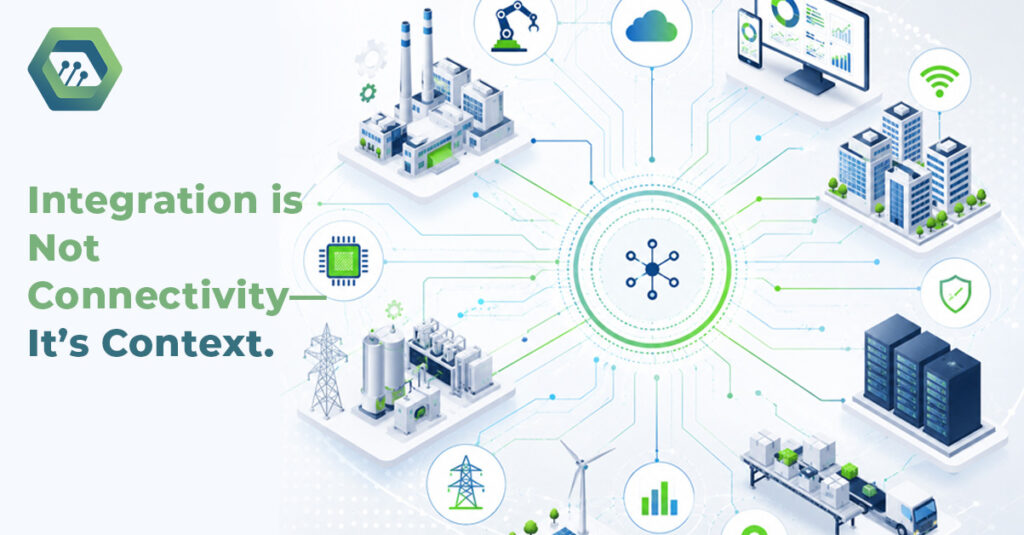
Rather than functioning as another monitoring platform, OmniWOT acts as a unified integration layer connecting:
Operational Technology (OT)
• Machines
• Sensors
• PLCs
• SCADA
• BMS
Enterprise Systems (IT)
• ERP
• MES
• CAFM
• CMMS
Infrastructure & Utilities
• Energy systems
• Water systems
• Building infrastructure
• Utility networks
This creates a single operational intelligence layer where context becomes visible across the organization.
Integration Is the Foundation of Industry 4.0
Industry 4.0 is often associated with:
• IoT
• Automation
• Artificial Intelligence
• Digital Twins
However, none of these technologies deliver their full value without integration.
Because intelligence emerges when systems work together.
Not when they operate independently.
Conclusion
Most organizations have already solved connectivity.
The next challenge is context.
Because:
Machine data alone has limited value.
Energy data alone has limited value.
Production data alone has limited value.
The real value emerges when these systems are connected, correlated, and understood together.
At OmniWOT, our mission is simple:
We don’t just connect data—we make it meaningful.
By creating context across operations, infrastructure, and business systems, OmniWOT helps organizations transform data into intelligence and intelligence into measurable business outcomes.
FAQ
What is the difference between connectivity and integration?
Connectivity allows systems to exchange data. Integration creates context by correlating data across systems to generate actionable insights.
Why is context important in Industry 4.0?
Context helps organizations understand relationships between systems, identify root causes, and make better operational decisions.
How does OmniWOT create operational intelligence?
OmniWOT integrates OT systems, enterprise applications, and infrastructure data into a unified platform that enables correlation and analytics.
What industries benefit from integrated intelligence?
Manufacturing, Smart Buildings, Utilities, Logistics, Campuses, Healthcare, and Industrial Enterprises.