

IoT Wearable Devices for Worker Safety: A Complete Guide
The Blind Spots of Industrial Safety
Walk into a heavy manufacturing facility, a deep underground mine, or a sprawling oil refinery, and you will see workers wearing standard Personal Protective Equipment (PPE)—hard hats, high-visibility vests, and steel-toed boots. While traditional PPE provides essential physical defense against impacts, it remains fundamentally passive. It cannot tell a supervisor if a technician has collapsed from heat exhaustion, if an engineer has wandered into an unventilated chemical zone, or if a lone worker has suffered an accident in a remote area.
In high-risk industrial environments, the biggest threat to life is often time. When an emergency occurs, every second lost between the incident and the alert reduces the chances of a successful rescue. Relying on manual check-ins, radio chatter, and visual supervision creates dangerous blind spots across large facilities.
Shifting from Passive PPE to Active Operational Intelligence
Modern Environment, Health, and Safety (EHS) leaders are realizing that true workforce safety requires connectivity. By integrating Internet of Things (IoT) wearable technology directly into frontline daily gear, organizations can bridge the critical gap between physical protection and real-time situational awareness.
OmniWOT’s Industrial Wearable Technology and Workforce Safety Solutions transform passive safety compliance into an active, centralized safety network. By pairing ruggedized frontline wearables with enterprise cloud monitoring, plant managers and safety directors gain real-time visibility over every worker’s location, health, and environment.
Two Pillars of Frontline IoT Protection
A truly effective safety ecosystem must be rugged, reliable, and unobtrusive for the worker. OmniWOT delivers this through two specialized, industrial-grade wearables:
-
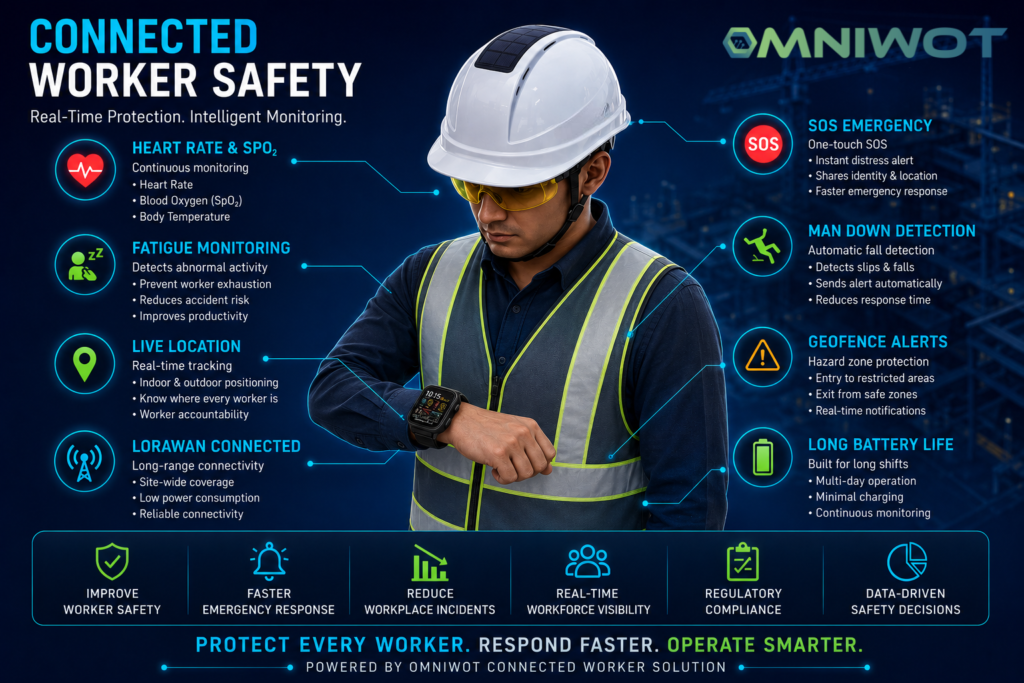
The J3 LoRaWAN Smart Wearable Watch: Engineered specifically for challenging environments where cellular signals fail, the J3 utilizes long-range LoRaWAN connectivity. It acts as a continuous safety companion on the worker’s wrist. Built with an automated “man-down” and fall-detection accelerometer, the device immediately triggers an alarm if an employee collapses or remains motionless. Workers can also press an instant SOS panic button to summon emergency medical teams. Crucially, the wearable monitors vital health biometrics—tracking heart rate spikes and body temperature—allowing supervisors to detect fatigue and heat stress before an accident happens.
-
The Solar-Powered Smart Safety Helmet: Heavy industry demands gear that can survive extreme conditions without requiring constant maintenance. The OmniWOT Smart Safety Helmet takes the traditional hard hat into the digital age. Featuring an integrated solar-charging panel, it ensures uninterrupted battery life even during long field shifts. The helmet combines precision GPS positioning with Bluetooth indoor beacons, allowing safety teams to locate personnel accurately across multi-level construction or mining sites. With built-in impact sensors and high-temperature alerts, the helmet instantly notifies the central command center the moment a worker suffers a blow or is exposed to dangerous thermal levels.
Dynamic Geofencing and Instant Hazard Prevention
One of the most powerful applications of industrial wearable technology is preventative zoning. Large processing plants often contain restricted chemical storage rooms, high-voltage substations, or active blasting zones.
Through the OmniWOT central dashboard, EHS managers can draw virtual geofenced perimeters around hazardous areas. If a worker wearing the J3 Watch or Smart Helmet accidentally crosses into a restricted zone without authorization, the wearable emits an immediate haptic and audible warning to alert the employee, while simultaneously notifying the control room. This proactive intervention prevents exposure to hazards before an incident can unfold.
Creating a Data-Driven Safety Culture
Investing in connected workforce safety does not just protect individual lives; it transforms operational efficiency. By aggregating wearable data over time, EHS teams can analyze near-miss heatmaps, identify high-risk zones, optimize patrol schedules, and streamline compliance reporting for regulatory audits.
Your workforce is the heartbeat of your industrial operation. Do not leave their safety to chance or delayed alarms. When every worker is connected and every hazardous zone is monitored in real time, you build a resilient safety culture where productivity and protection go hand in hand.
-
👉 Explore the J3 LoRa Wearable Watch: https://omniwot.com/product/j3-lora-wearable/
-
👉 Discover the Solar-Powered Smart Safety Helmet: https://omniwot.com/product/solar-powered-smart-safety-helmet/