

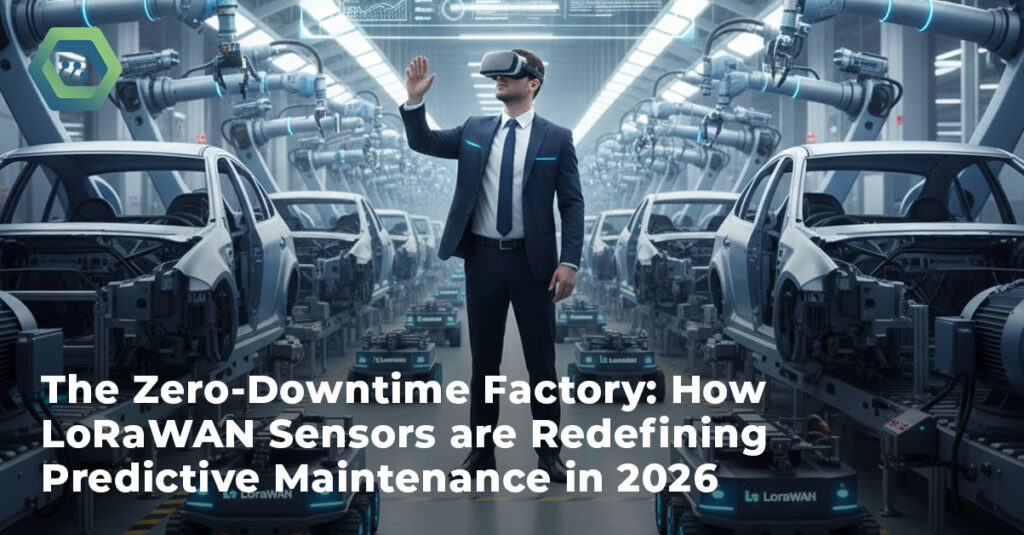
In the manufacturing world of 2026, the sound of a machine breaking down is becoming a relic of the past. For decades, factory managers were trapped in a cycle of “fix it when it breaks” (reactive) or “fix it even if it’s fine” (preventative). Both are expensive. One leads to catastrophic production halts; the other leads to wasted parts and unnecessary labor.
The “Zero-Downtime Factory” is no longer a futuristic concept—it is a result of Predictive Maintenance (PdM) powered by LoRaWAN sensors. By listening to the “heartbeat” of machinery, LoRaWAN is helping industries move from scheduled maintenance to intelligence-based action.
The Connectivity Barrier: Why Wi-Fi and Cables Failed
In the past, the biggest hurdle to predictive maintenance was the cost of connectivity.
- Wired Sensors: Running ethernet or power cables to thousands of motors and pumps in a massive facility can cost five times more than the sensors themselves.
- Wi-Fi/Bluetooth: These struggle with the “Faraday Cage” effect—signals are often blocked by dense steel structures and heavy machinery.
LoRaWAN (Long Range Wide Area Network) has shattered these barriers. With its ability to penetrate deep into industrial basements and reach across 15km of factory floor, it provides the robust, low-cost “nervous system” required for a truly connected plant.
4 Ways LoRaWAN Sensors Predict the Future
Modern LoRaWAN-enabled sensors monitor the four critical pillars of machine health:
1. Vibration Analysis (The Early Warning)
Bearings and rotating shafts give off specific high-frequency vibrations weeks before they fail. LoRaWAN vibration sensors (accelerometers) capture these patterns and use Fast Fourier Transform (FFT) analysis to identify imbalance, misalignment, or wear.
The 2026 Edge: AI models now achieve over 90% accuracy in predicting failures up to 60 days in advance.
2. Thermal Imaging & Temperature Trends
Excessive friction or electrical resistance creates heat. LoRaWAN temperature sensors provide constant monitoring of gearboxes and electrical panels. A gradual upward trend in temperature—invisible to the human eye—is often the first sign of a lubrication failure.
3. Acoustic Monitoring (The “Golden Ears”)
Acoustic sensors “hear” leaks in compressed air systems or the high-pitched “hiss” of electrical arcing. In 2026, these sensors act as the 24/7 digital equivalent of your most experienced mechanic’s ears.
4. Power Quality & Current Draw
By monitoring the current draw of a motor via LoRaWAN, systems can detect if a machine is working harder than it should. A sudden spike in power consumption often signals an internal blockage or mechanical strain.
The ROI: From Cost Center to Profit Driver
According to recent 2026 industry reports, the shift to LoRaWAN-based predictive maintenance is delivering staggering results:
- Unplanned Downtime: Reduced by 30% to 50%.
- Maintenance Costs: Lowered by 25% through the elimination of unnecessary “time-based” part replacements.
- Asset Longevity: Machine lifespans are extended by 3–5 years by addressing minor issues before they cause “collateral damage” to the whole system.
- Energy Efficiency: Well-maintained machines operate with less friction, typically reducing energy bills by 10–15%.
Implementing the “Install and Forget” Strategy
The beauty of LoRaWAN for the 2026 factory is its simplicity. Because these sensors are battery-powered (lasting 5–10 years) and wireless, a “brownfield” plant built in the 1980s can be digitized in a matter of days.
- Deploy: Clip sensors onto motors, pumps, and fans.
- Connect: A single LoRaWAN gateway handles thousands of sensors.
- Analyze: Data flows into an AI-driven dashboard that sends an SMS or email alert only when action is needed.
Conclusion: The Era of Prescriptive Maintenance
We are moving beyond just predicting a break. In 2026, the most advanced factories use Prescriptive Maintenance. Not only does the LoRaWAN sensor tell you a bearing will fail in two weeks; it automatically checks the digital inventory for the spare part and schedules the repair during the next planned shift change.
The result? A factory that never stops.