
Industrial enterprises are undergoing rapid digital transformation.
• Factories are adopting automation.
• Buildings are becoming smarter.
• Utilities are becoming data-driven.
Yet despite significant technology investments, one challenge continues to limit operational performance:
Systems remain disconnected.
Machines generate data.
SCADA systems monitor processes.
ERP platforms manage business operations.
But in many organizations, these systems operate independently.
The result is fragmented visibility, delayed decision-making, and missed opportunities for optimization.
At OmniWOT, we believe the future of industrial transformation is not simply about deploying more technology.
It is about creating Industrial Intelligence through integration.
The Industrial Data Problem
Most enterprises already possess the data required to improve operations.
The challenge is that the data exists in different locations:
• Machines and sensors generate operational data
• PLCs and SCADA systems control processes
• BMS platforms manage facilities
• ERP systems manage business operations
• Utilities generate energy and consumption data
Each system performs its role effectively.
However, very few organizations have a mechanism to unify these data sources into a single operational intelligence layer.
As a result:
❌ Operational silos emerge
❌ Critical insights remain hidden
❌ Decision-making slows down
❌ Business teams lack operational visibility
❌ Operational teams lack business context
OmniWOT Is Not Another IoT Platform
Many organizations assume digital transformation requires yet another software platform.
The reality is different.
Most enterprises do not need more dashboards.
They need connectivity.
They need orchestration.
They need integration.
OmniWOT was designed to solve this challenge.
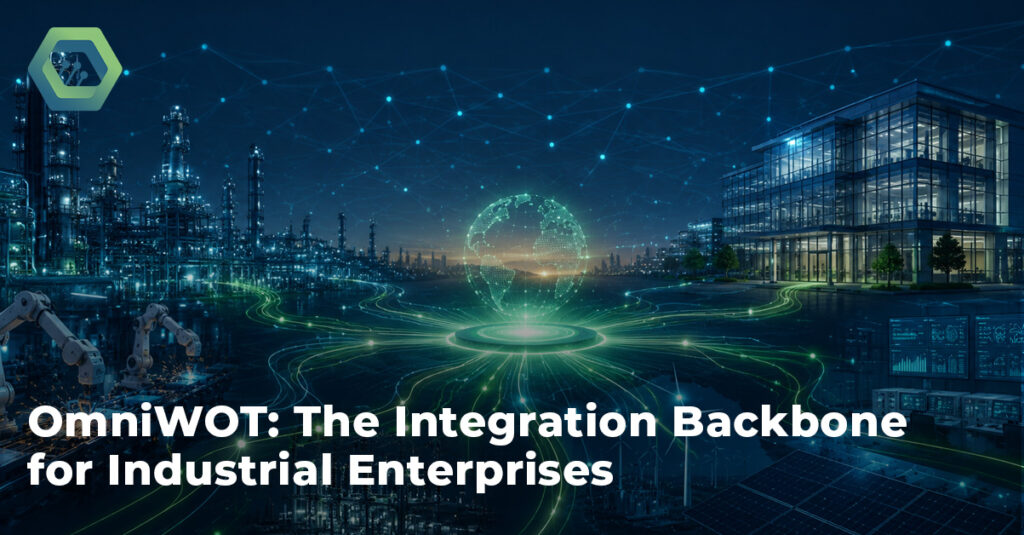
Rather than functioning as a standalone monitoring application, OmniWOT acts as a unified integration layer that connects operational technology and enterprise technology.
Connecting Operations and Business
Think of OmniWOT as the bridge between operations and business.
OmniWOT connects:
Machines & Sensors (OT)
• Industrial IoT Devices
• Condition Monitoring Sensors
• Energy Meters
• Environmental Monitoring Sensors
• Legacy Industrial Equipment
Control Systems
• SCADA
• PLC
• BMS
• DCS
• Industrial Automation Platforms
Enterprise Systems
• ERP
• MES
• CAFM
• CMMS
• Asset Management Platforms
Utilities & Infrastructure
• Power Systems
• Water Networks
• Renewable Energy Assets
• HVAC Infrastructure
• Building Utilities
The result is a connected ecosystem where data flows seamlessly between operational assets and business systems.
Why Industrial Intelligence Matters
Digital transformation initiatives often focus on collecting more data.
Industrial Intelligence focuses on using data more effectively.
When systems are integrated:
✔ Operational events become business insights
✔ Asset performance becomes measurable
✔ Energy consumption becomes actionable
✔ Maintenance becomes predictive
✔ Decision-making becomes real-time
The value of data increases exponentially when systems communicate.
Embedded Use Case 1
Machine-to-ERP Integration in Manufacturing
In many manufacturing facilities, production equipment and ERP systems operate independently.
Production teams see machine performance.
Management teams see business metrics.
The connection between the two is often missing.
With OmniWOT:
Machine performance data flows directly into ERP systems.
Production output, downtime events, machine utilization, and asset health become visible at the business level.
Benefits
• Real-time production visibility
• Improved planning accuracy
• Better inventory management
• Faster operational decision-making
• Reduced production losses
Instead of managing production and business separately, organizations operate from a unified intelligence layer.
Embedded Use Case 2
BMS Integration for Building Energy Optimization
Commercial buildings generate enormous amounts of operational data.
HVAC systems.
Lighting systems.
Energy meters.
Utilities.
Most operate independently.
Through OmniWOT integration:
BMS data becomes actionable intelligence.
Organizations gain:
• Real-time energy visibility
• Automated optimization strategies
• Occupancy-driven controls
• Utility benchmarking
• Sustainability reporting
Business Impact
✔ Lower energy consumption
✔ Reduced operational costs
✔ Improved ESG performance
✔ Smarter facility management
Building data transforms into measurable business outcomes.
Embedded Use Case 3
Grid-to-Consumption Analytics for Utilities
Utility providers and large energy consumers often struggle with fragmented visibility between supply and consumption.
OmniWOT bridges this gap.
By integrating:
• Grid data
• Energy meters
• Renewable energy assets
• Consumption infrastructure
Organizations gain a complete picture of energy flow.
Benefits
• Real-time consumption monitoring
• Demand optimization
• Peak load management
• Energy forecasting
• Utility cost reduction
Energy intelligence becomes a strategic business asset.
The Foundation of Industry 4.0
Industry 4.0 is often associated with:
• Automation
• Robotics
• Artificial Intelligence
• Industrial IoT
While these technologies are important, they deliver maximum value only when connected.
The next phase of Industry 4.0 is not about deploying more systems.
It is about creating synchronization between systems.
Because:
The next competitive advantage is not automation.
It is integration.
From Data Collection to Industrial Intelligence
Many organizations focus on monitoring.
Fewer focus on intelligence.
Industrial Intelligence occurs when:
Data is collected.
Systems communicate.
Insights are generated.
Actions are automated.
Business decisions improve.
This is where OmniWOT creates value.
Not simply by collecting information.
But by transforming information into operational and business intelligence.
Why Enterprises Choose OmniWOT
Organizations choose OmniWOT because it enables:
Unified Visibility
Monitor operations, facilities, utilities, and assets from a single platform.
Multi-Protocol Integration
Connect BACnet, Modbus, MQTT, OPC-UA, PLCs, SCADA systems, and legacy infrastructure.
Edge-to-Cloud Architecture
Real-time local control combined with enterprise-scale analytics.
Scalable Deployment
Support factories, campuses, utilities, smart buildings, and industrial enterprises.
Future-Ready Infrastructure
Built to support Industry 4.0, Industrial IoT, Digital Twins, AI Analytics, and Predictive Maintenance.
Conclusion
The industrial world does not have a technology shortage.
It has an integration challenge.
Machines are becoming smarter.
Buildings are becoming connected.
Utilities are becoming digital.
The organizations that gain the greatest advantage will be those that successfully connect operations and business into a single intelligence layer.
OmniWOT is that bridge.
By connecting machines, control systems, enterprise applications, and infrastructure, OmniWOT enables enterprises to move beyond monitoring and into Industrial Intelligence.
Because the future belongs to organizations that can transform data into synchronized action.
And action into competitive advantage.
FAQ
What is Industrial Intelligence?
Industrial Intelligence is the ability to convert operational data from machines, infrastructure, and enterprise systems into actionable business insights.
How is OmniWOT different from traditional IoT platforms?
OmniWOT acts as a unified integration layer connecting OT systems, enterprise applications, and infrastructure rather than functioning as a standalone monitoring platform.
Can OmniWOT integrate with existing SCADA and PLC systems?
Yes. OmniWOT supports integration with legacy and modern SCADA, PLC, BMS, and industrial automation systems.
What industries benefit from OmniWOT?
Manufacturing, Smart Buildings, Utilities, Logistics, Campuses, Healthcare, Industrial Facilities, and Infrastructure Projects.