
Digital transformation is no longer optional — it’s the backbone of operational efficiency across industries.
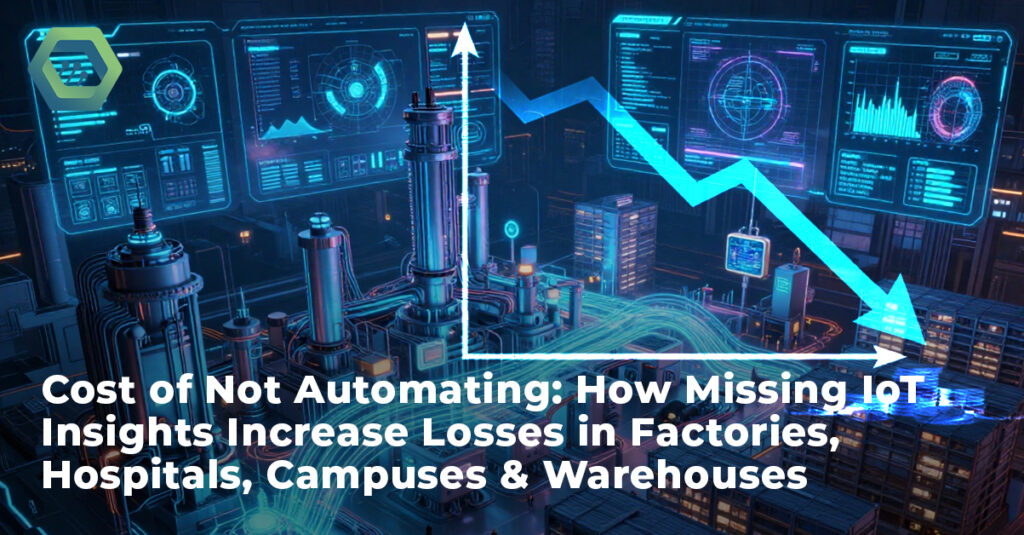
But while many organizations know the value of IoT, most don’t realize the massive hidden cost of NOT automating.
Every day without IoT insights results in:
❌ Wasted energy
❌ Unplanned downtime
❌ Safety risks
❌ Inventory spoilage
❌ Workforce inefficiency
❌ Higher insurance claims
❌ Slow decision-making
From factories to hospitals, from campuses to warehouses, the real losses don’t show up on balance sheets — but they hit hardest.
This blog exposes what industries lose every day without IoT automation and how platforms like OmniWOT turn operational blind spots into profitable insights.
1. The Silent Cost of Blind Operations
Most industries still operate with delayed, incomplete, or manual data.
When managers can’t see real-time operations, they rely on guesswork.
And guesswork is expensive.
Hidden losses in non-automated environments:
- Equipment failures go undetected until it’s too late
- Energy leaks continue for months
- Safety violations go unnoticed
- Assets disappear without traceability
- Manual logs cause human errors
- Maintenance is reactive, not predictive
This data darkness leads to direct financial impact, often far more than the cost of IoT adoption.
2. Factories: Downtime, Quality Loss & High Energy Bills
Manufacturers experience massive preventable expenses due to missing real-time visibility.
Without IoT automation, factories face:
- Unplanned downtime (40% of annual equipment loss)
- Poor OEE due to manual reporting
- Overheating motors and pumps that fail without warning
- Energy wastage in machines left running idle
- Lack of condition monitoring leading to expensive repairs
- No traceability for compliance audits
Every hour of machine downtime in India costs between ₹1–₹30 lakhs, depending on industry.
Factories using OmniWOT’s unified IoT platform experience:
✔ Predictive maintenance
✔ Condition monitoring
✔ Real-time alerts
✔ Lower operational costs
✔ 24/7 visibility from any device
3. Hospitals: Patient Safety Risks & Equipment Inefficiency
Healthcare environments cannot afford delays — yet many still depend on manual monitoring.
Impact of missing IoT in hospitals:
- Late detection of critical patient changes
- Loss of expensive medical assets (wheelchairs, pumps)
- Cold storage failures in pharmacies/labs leading to spoiled vaccines/medicines
- High energy consumption in ICU/HVAC zones
- Zero visibility into equipment utilisation
IoT-enabled hospitals improve patient outcomes through:
✔ 24/7 equipment tracking
✔ Smart cold chain monitoring
✔ Live health parameter insights
✔ Automated alerts
✔ Energy optimization
A single cold storage failure can destroy lakhs worth of medication — automation prevents that.
4. Campuses & Institutions: Inefficient Buildings & Poor Resource Management
Smart campuses require high visibility across thousands of students, rooms, and facilities.
Without IoT:
- Energy bills skyrocket
- HVAC and lighting run unnecessarily
- No occupancy-based optimisation
- Security gaps remain hidden
- Asset tracking becomes impossible
IoT transforms campus operations by:
✔ Reducing electricity costs by 20–35%
✔ Improving indoor air quality
✔ Enhancing student safety with wearables & RTLS
✔ Optimising classroom utilisation
✔ Providing a unified dashboard for all buildings
5. Warehouses: Inventory Loss, Safety Incidents & Inefficient Logistics
Warehouses lose lakhs per year due to lack of IoT visibility.
Key losses caused by non-automation:
- Inventory spoilage (cold storage without monitoring)
- Forklift safety incidents
- Misplaced pallets
- Manual errors in operations
- Inability to track loading/unloading time
- High energy usage in large facilities
OmniWOT-enabled warehouses gain:
✔ Real-time tracking
✔ Environmental monitoring
✔ Worker safety wearables
✔ Workflow optimization
✔ Predictive equipment alerts
6. The Unified Impact: Lost Insights = Lost Money
When industries depend on manual processes or siloed systems, they suffer from:
Operational Blind Spots
No visibility = No control.
Financial Leakage
Every inefficiency compounds over months or years.
Poor Scalability
Disconnected systems cannot support growth.
Safety & Compliance Risk
Lack of automated alerts increases liability.
Data Fragmentation
Multiple dashboards = confusion + delayed decisions.
A unified IoT platform like OmniWOT ensures that every sensor, device, and asset speaks one language — delivering complete operational clarity.
7. Why OmniWOT Solves This Problem Better Than Others
Most IoT platforms fail because they:
❌ Don’t support multi-protocol devices
❌ Cannot onboard hardware from different brands
❌ Rely only on cloud processing
❌ Lack digital twin visualization
❌ Don’t scale for Indian deployment conditions
❌ Fail in remote areas due to weak connectivity
OmniWOT eliminates these limitations with:
✔ Multi-Protocol Support: LoRaWAN, BLE, Modbus, CAN bus, BACnet, NB-IoT, MQTT
✔ Plug & Play Device Onboarding
✔ digiTWIN — Cloud-Based Digital Twin Visualization
✔ Edge + Cloud Hybrid Architecture
✔ Real-Time AI Insights & Smart Alerts
✔ Unified Dashboard for All Departments
✔ Scalable from 10 devices to 1 million+
✔ Compatible with any sensor, any hardware
With OmniWOT, organizations stop guessing and start making decisions backed by live operational intelligence.
8. Final Thoughts: The Real Cost Is Doing Nothing
In 2025, automation is no longer a competition — it’s survival.
Industries that delay IoT adoption will:
❌ Spend more
❌ Operate slower
❌ Face higher downtime
❌ Lose customers
❌ Miss insights competitors already have
Industries using OmniWOT will:
✅ Improve efficiency
✅ Reduce energy & maintenance costs
✅ Enhance safety
✅ Prevent losses
✅ Scale faster
The cost of automating is measurable.
The cost of NOT automating is unlimited.