

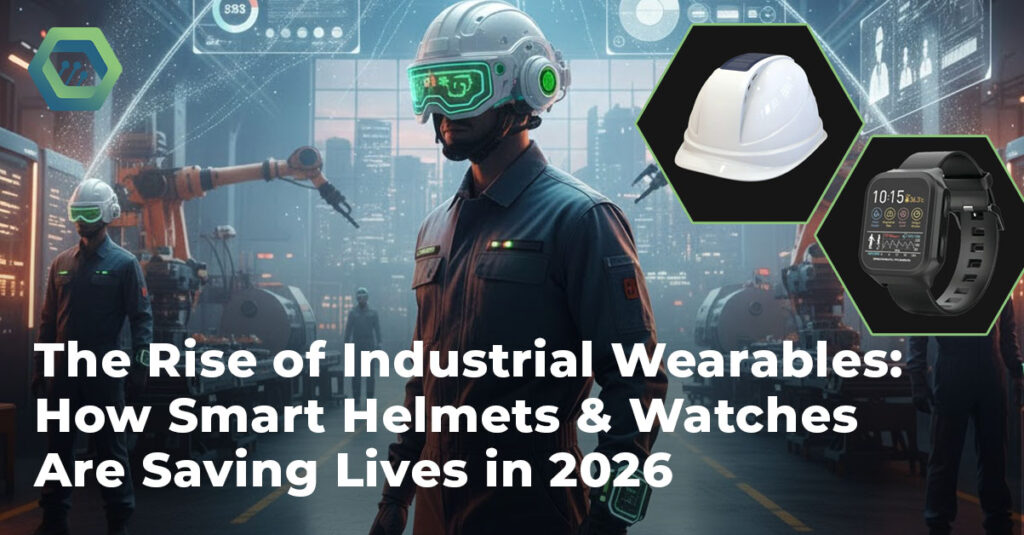
Industrial safety is undergoing a fundamental shift.
In 2025, safety is no longer limited to helmets, badges, or manual supervision. It’s becoming intelligent, connected, and proactive — powered by industrial IoT wearables.
Across construction sites, factories, mines, oil & gas facilities, logistics hubs, and campuses, smart helmets and smart watches are emerging as critical tools that don’t just protect workers — they actively prevent accidents, save lives, and reduce operational risk.
This blog explores why industrial wearables are rising fast, how they work, the real-world problems they solve, and why platforms like OmniWOT are central to making them effective at scale.
1. Why Traditional Safety Systems Are No Longer Enough
Despite safety protocols, industrial accidents remain alarmingly common.
The root problem isn’t lack of rules — it’s lack of real-time visibility.
Traditional safety challenges include:
- Delayed incident reporting
- No visibility into worker fatigue or inactivity
- Inability to detect falls or impacts instantly
- Manual headcounts during emergencies
- No data-driven insight into unsafe zones
- Compliance tracked on paper, not reality
In high-risk environments, minutes matter — and manual systems react too late.
This gap is driving rapid adoption of industrial IoT wearables.
2. What Are Industrial Wearables?
Industrial wearables are connected safety devices designed specifically for harsh, high-risk work environments.
Common examples include:
- Smart Safety Helmets
- Smart Watches / Wearable Trackers
- Smart badges and RTLS tags
Unlike consumer wearables, these devices are:
- Rugged and industrial-grade
- Designed for continuous operation
- Integrated with IoT platforms
- Built for real-time monitoring and alerts
They turn every worker into a connected safety node.
3. Smart Helmets: When PPE Becomes Intelligent
Smart helmets are redefining what personal protective equipment (PPE) means.
Key capabilities of smart helmets in 2026:
- Fall and impact detection
- Helmet removal detection
- High-voltage proximity alerts
- Temperature and altitude monitoring
- Inactivity detection
- SOS emergency button
- Voice, buzzer, and LED alerts
- Solar + battery dual power
- Multi-network connectivity (LoRaWAN, GPS, BLE)
- Offline data logging during network loss
Instead of relying on visual supervision, safety teams receive real-time alerts the moment something goes wrong.
In mining, construction, and utilities, smart helmets are proving to be life-saving devices, not just protective gear.
4. Smart Watches: Monitoring the Worker, Not Just the Workplace
While helmets monitor the environment, smart watches focus on the worker’s condition.
Industrial smart watch use cases include:
- Location tracking (indoor & outdoor)
- Worker inactivity or man-down alerts
- Emergency SOS triggering
- Shift movement tracking
- Restricted zone breach alerts
- Health & fatigue indicators (where applicable)
These wearables ensure that:
- Lone workers are never invisible
- Emergency response teams act faster
- Evacuations are data-driven, not chaotic
- Workforce compliance improves automatically
In logistics, warehouses, and large campuses, smart watches are becoming essential safety infrastructure.
5. Real-World Impact: How Wearables Save Lives
The biggest value of industrial wearables lies in prevention, not reaction.
Real safety improvements seen with wearables:
- Faster emergency response times
- Reduced fatal accidents from falls and electrocution
- Immediate alerts before unsafe conditions escalate
- Accurate worker location during emergencies
- Reduced insurance claims and legal exposure
- Improved compliance without manual policing
When combined with automation, wearables shift safety from reactive reporting to proactive intervention.
6. The Role of IoT Platforms: Why Wearables Alone Are Not Enough
A smart helmet without a platform is just a sensor.
The real intelligence comes from the IoT platform behind it.
Without a unified platform:
- Alerts are siloed
- Data is fragmented
- Safety insights are lost
- Scaling becomes impossible
This is where OmniWOT makes the difference.
OmniWOT connects helmets, watches, sensors, gateways, and controllers into one unified system — regardless of hardware brand or protocol.
7. How OmniWOT Powers Industrial Wearables at Scale
OmniWOT is built for real-world industrial deployments, not lab environments.
What OmniWOT enables for wearables:
- Multi-protocol support (LoRaWAN, BLE, NB-IoT, MQTT, GPS)
- Real-time dashboards for safety teams
- Automated alerts & workflows
- Offline data sync and edge intelligence
- Centralized monitoring across sites
- digiTWIN visualization for worker & asset tracking
- Scalable deployment from 10 to 1,000,000+ devices
This allows organizations to manage worker safety, compliance, and response from a single platform.
8. Industries Driving Wearable Adoption in 2026
Industrial wearables are seeing rapid adoption across:
- Mining & Construction – fall detection, high-voltage alerts
- Manufacturing – restricted zone monitoring, inactivity alerts
- Oil & Gas – hazardous area safety
- Logistics & Warehouses – worker tracking, emergency response
- Utilities & Power Plants – electrocution risk monitoring
- Smart Campuses & Infrastructure – centralized safety oversight
In all these sectors, safety is becoming data-driven, measurable, and auditable.
9. Business Benefits Beyond Safety
While saving lives is the primary goal, wearables also deliver strong business ROI:
- Lower accident-related downtime
- Reduced insurance premiums
- Better compliance reporting
- Improved workforce productivity
- Faster incident investigation
- Stronger safety culture
In 2025, safety is no longer a cost center — it’s a performance metric.
10. Final Thoughts: Safety Is Becoming Intelligent
Industrial wearables are no longer experimental.
They are becoming the new standard for workplace safety.
Smart helmets and watches don’t just protect workers — they:
- Predict risks
- Prevent incidents
- Enable faster decisions
- Create safer workplaces
With a unified IoT platform like OmniWOT, organizations can move from manual supervision to intelligent protection.
In 2026, the safest workplaces are the most connected ones.