
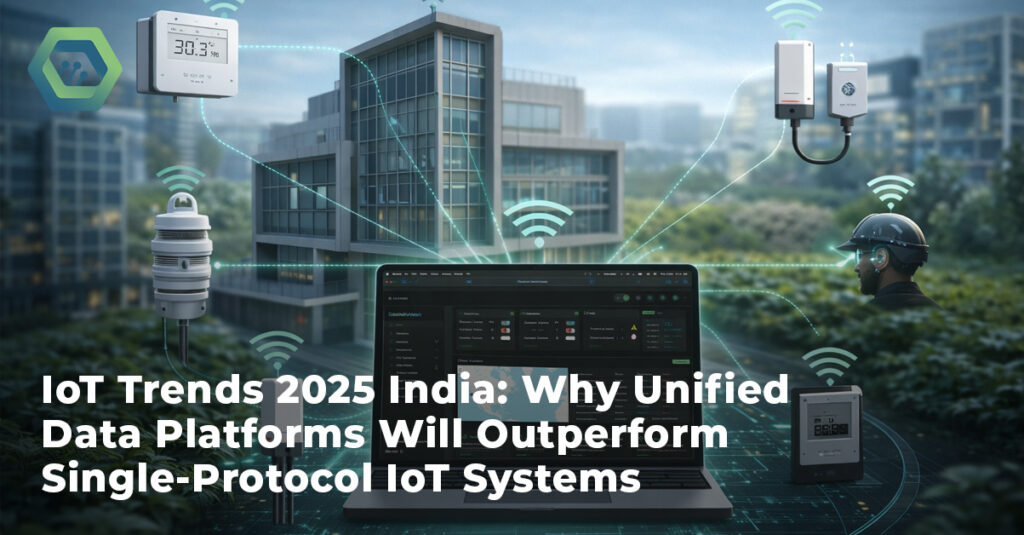
By 2026, IoT in India has moved decisively from experimentation to enterprise-scale execution.
Factories, hospitals, campuses, warehouses, and smart infrastructure projects are no longer asking if they should deploy IoT—but how to scale it without losing control, visibility, or ROI.
As deployments mature, one trend stands above the rest:
👉 Unified data platforms are outperforming single-protocol IoT systems—by a wide margin.
This blog explores why unified IoT platforms are becoming the default architecture in India for 2026, what single-protocol systems fail to deliver, and how forward-looking organizations are future-proofing their IoT investments.
1. IoT in India, 2026: A Reality Check
India’s IoT ecosystem in 2026 is defined by complexity at scale:
- LoRaWAN sensors for long-range monitoring
- BLE for indoor tracking and configuration
- Modbus and BACnet for legacy infrastructure
- CAN bus for machinery and automation
- Cellular and edge computing for remote sites
Most organizations are already running multiple protocols simultaneously—often unknowingly.
The real challenge is no longer connectivity.
It’s data unification.
2. Why Single-Protocol IoT Systems Are Falling Behind
Single-protocol IoT systems were effective when deployments were small and isolated.
In 2026, they struggle to survive real-world conditions.
Key limitations:
- Can’t integrate legacy and modern devices together
- Force teams to manage multiple dashboards
- Create data silos across departments
- Increase integration and maintenance costs
- Fail to scale across sites and use cases
What begins as a “simple deployment” quickly becomes a complex operational burden.
3. Unified Data Platforms: The 2026 Standard
Unified IoT platforms are built for heterogeneous environments—the reality of Indian industry.
Instead of locking into one protocol, they:
- Support multiple protocols natively
- Normalize data into a common structure
- Provide one operational dashboard
- Enable cross-system analytics
- Scale horizontally without redesign
In 2026, interoperability beats specialization.
4. Unified Data = Smarter, Faster Decisions
When all data lives in one platform, organizations can finally:
- Correlate energy usage with machine behavior
- Link safety incidents to location and environment
- Connect maintenance trends to downtime costs
- Align operations data with financial KPIs
This transforms IoT from monitoring technology into a decision-making engine.
5. Industry Impact Across India
Manufacturing
- Combines PLC data with wireless sensors
- Enables predictive maintenance
- Improves OEE and energy efficiency
Healthcare
- Centralizes asset tracking, cold storage, and environment monitoring
- Improves compliance and patient safety
Campuses & Institutions
- Unifies energy, air quality, occupancy, and security data
- Delivers measurable cost savings
Warehousing & Logistics
- Prevents inventory loss
- Improves safety and operational flow
Across industries, unified platforms act as a single source of truth.
6. ROI: Where Unified Platforms Win
Single-protocol systems appear cheaper upfront—but cost more over time.
Unified platforms reduce Total Cost of Ownership (TCO) by:
- Eliminating duplicate systems
- Reducing integration effort
- Minimizing manual reporting
- Improving operational efficiency
In India’s value-driven market, clear ROI is non-negotiable in 2026.
7. What to Look for in a Unified IoT Platform (2026 Checklist)
✔ Multi-protocol support (LoRaWAN, BLE, Modbus, BACnet, CAN bus)
✔ Single, centralized dashboard
✔ Edge + cloud hybrid architecture
✔ Offline data buffering
✔ Real-time alerts and automation
✔ Digital twin or advanced visualization
✔ Scalable across industries
✔ Hardware-agnostic design
Platforms missing these capabilities risk rapid obsolescence.
8. How OmniWOT Aligns with IoT Trends 2026
OmniWOT is built for India’s multi-protocol, multi-industry reality.
It enables:
- Unified ingestion of all major IoT protocols
- Centralized dashboards for operations and leadership
- Real-time monitoring, alerts, and automation
- digiTWIN-based visualization
- Seamless scale from pilot to enterprise
OmniWOT doesn’t replace systems—it connects and amplifies them.
9. The Future: From IoT Systems to IoT Ecosystems
By the end of 2026, IoT leaders in India will shift from:
- Devices → Data ecosystems
- Dashboards → Intelligence layers
- Monitoring → Predictive and prescriptive operations
Unified data platforms will be the foundation of this evolution.
Final Thoughts
In 2026, IoT success in India is no longer about choosing the “right protocol.”
It’s about choosing the right architecture.
Single-protocol systems served their time.
The future belongs to unified, flexible, and intelligent IoT platforms.