
In India, IoT adoption has moved beyond experimentation. Factories, hospitals, campuses, warehouses, and infrastructure projects are deploying sensors, controllers, and wearables at scale.
Yet despite growing IoT investments, many organizations still ask a critical question:
“Why isn’t our IoT delivering clear financial returns?”
The answer is rarely about the sensors.
It’s about visibility.
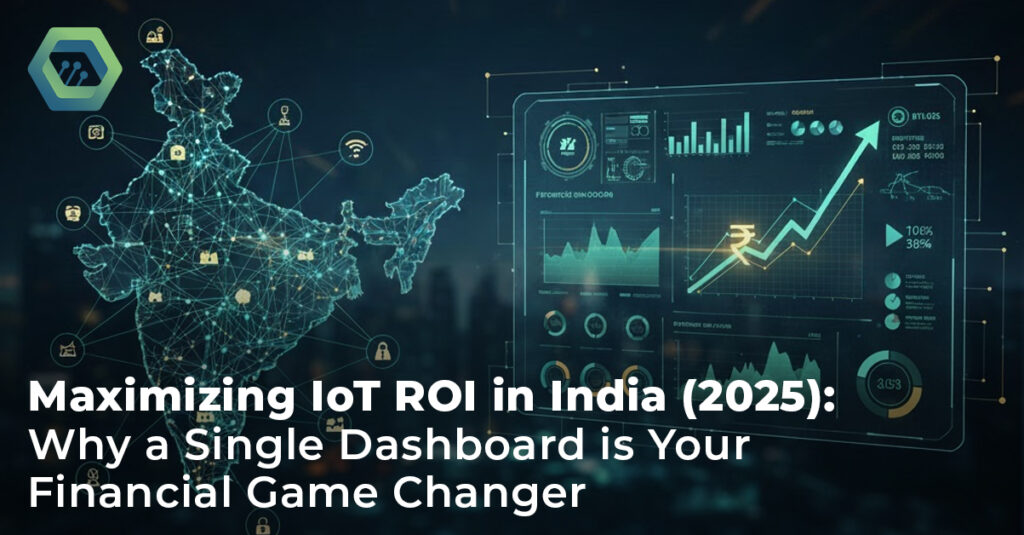
In 2025, the biggest difference between IoT success and failure in India is whether all operational data lives on a single, unified dashboard — or remains scattered across disconnected systems.
This blog explains why a single IoT dashboard has become a financial game changer, how fragmented data silently erodes ROI, and how platforms like OmniWOT help Indian businesses turn IoT data into measurable business outcomes.
1. The IoT ROI Problem in India
Indian enterprises are deploying IoT faster than ever — but ROI often lags behind expectations.
Common symptoms include:
- Multiple dashboards for different sensors
- Separate systems for energy, safety, assets, and machines
- Manual consolidation of reports
- Delayed decision-making
- No real-time financial visibility
The result?
IoT data exists, but insights don’t.
When data is fragmented, finance teams can’t measure savings, operations teams can’t act fast, and leadership can’t justify scaling IoT investments.
2. The Hidden Cost of Fragmented Dashboards
Each disconnected dashboard adds invisible cost to your operations.
Where money leaks without a unified view:
- Energy waste goes unnoticed across buildings or plants
- Downtime patterns remain hidden until failures occur
- Maintenance costs rise due to reactive repairs
- Inventory loss happens without traceability
- Safety incidents increase liability and insurance costs
- Manual reporting consumes time and introduces errors
Individually, these losses seem small.
Collectively, they erode margins every month.
In 2025, lack of visibility is a financial risk.
3. Why a Single IoT Dashboard Changes Everything
A single IoT dashboard doesn’t just consolidate data — it connects operations to financial outcomes.
What a unified dashboard enables:
- One real-time view across all sites and systems
- Correlation between energy, equipment, people, and processes
- Faster response to anomalies and inefficiencies
- Clear measurement of savings and ROI
- Confident, data-backed decision-making
Instead of asking “What happened?”, teams can ask:
“Why did it happen, what will happen next, and how much will it cost?”
4. Finance Teams Are Now Driving IoT Decisions
In 2025, IoT is no longer owned only by IT or engineering teams.
CFOs and finance leaders are deeply involved.
Why?
Because a single dashboard enables:
- Accurate cost attribution
- Real-time OPEX monitoring
- CAPEX justification for expansion
- Predictable maintenance budgets
- Compliance and audit readiness
When financial data aligns with operational data, IoT becomes a profit enabler, not a cost center.
5. Industry Impact: Where Unified Dashboards Deliver ROI
Factories
- Reduced unplanned downtime
- Predictive maintenance insights
- Energy optimization across machines
- Improved OEE and productivity
Hospitals
- Asset utilization visibility
- Cold storage compliance for medicines
- Energy savings in HVAC and critical zones
- Faster emergency response
Campuses & Institutions
- 20–35% reduction in energy costs
- Occupancy-based optimization
- Improved safety and compliance
- Centralized monitoring across buildings
Warehouses & Logistics
- Inventory loss prevention
- Equipment tracking
- Worker safety visibility
- Reduced operational delays
In every case, the dashboard becomes the control center for financial efficiency.
6. Why Most IoT Platforms Still Fall Short
Many IoT platforms promise dashboards — but fail to deliver real ROI because they:
- Support only limited protocols
- Create separate views for each system
- Lack semantic data unification
- Depend heavily on cloud-only processing
- Don’t scale across sites or industries
- Fail in low-connectivity environments
A dashboard without context, correlation, and continuity is just another screen.
7. How OmniWOT Delivers ROI Through a Unified Dashboard
OmniWOT is designed for real-world Indian deployments, where complexity is the norm.
What makes OmniWOT different:
- Multi-protocol support: LoRaWAN, BLE, Modbus, BACnet, CAN bus, NB-IoT, MQTT
- Single, unified dashboard for all devices and data
- Edge + cloud architecture for reliability
- digiTWIN visualization for assets and operations
- Real-time alerts & automation
- Scalable from small pilots to nationwide deployments
Instead of siloed data, OmniWOT delivers one version of operational truth — ready for action and financial analysis.
8. Turning Data into Measurable Financial Gains
With OmniWOT’s unified dashboard, organizations can:
- Identify inefficiencies in minutes, not months
- Reduce energy and maintenance costs
- Prevent downtime before it impacts revenue
- Improve safety and reduce liability exposure
- Justify IoT investments with real numbers
This is how IoT moves from technology spend to business strategy.
9. Final Thoughts: Visibility Is the New Currency
In India’s competitive landscape, speed and clarity define winners.
By 2025, businesses that succeed with IoT will not be those with the most sensors —
but those with the clearest, most unified view of their operations.
A single dashboard is no longer a “nice-to-have.”
It is the financial backbone of modern IoT deployments.