

The Costliest Machine Failure Is the One You Never Saw Coming
Across manufacturing plants, commercial buildings, utilities, logistics hubs, and industrial facilities, one challenge continues to impact profitability more than almost any other:
Unplanned downtime.
Unexpected equipment failures interrupt production, increase maintenance costs, reduce asset lifespan, delay deliveries, and negatively affect customer satisfaction.
For many organizations, these failures aren’t caused by a lack of maintenance—they’re caused by maintaining equipment too late or too often.
This is why enterprises worldwide are investing in predictive maintenance.
More importantly, they are measuring the Predictive Maintenance ROI that comes from preventing failures before they happen.
In 2026, predictive maintenance is no longer viewed as a maintenance strategy—it has become a business strategy.
What Is Predictive Maintenance?
Predictive maintenance (PdM) is a proactive maintenance approach that uses IoT sensors, real-time monitoring, AI analytics, and condition-based data to predict equipment failures before they occur.
Instead of servicing equipment on fixed schedules or waiting for breakdowns, organizations maintain assets only when performance data indicates it is necessary.
A modern predictive maintenance solution continuously analyzes:
- Temperature
- Vibration
- Pressure
- Current consumption
- Motor performance
- Energy usage
- Runtime hours
- Environmental conditions
These insights allow maintenance teams to identify anomalies early, reducing downtime and improving operational efficiency.
Understanding Predictive Maintenance ROI
Predictive Maintenance ROI measures the business value gained from implementing predictive maintenance technologies compared to the investment required.
Unlike traditional maintenance programs that focus only on repairs, predictive maintenance delivers value across multiple business functions.
Organizations typically measure Predictive Maintenance ROI through:
- Reduced unplanned downtime
- Lower maintenance costs
- Increased asset availability
- Improved production efficiency
- Lower energy consumption
- Extended equipment lifespan
- Better workforce productivity
- Higher Overall Equipment Effectiveness (OEE)
The return is not limited to maintenance teams—it impacts operations, finance, sustainability, and executive decision-making.
Why Reactive Maintenance Is No Longer Sustainable
Many industrial organizations still rely on reactive maintenance.
Equipment fails.
Maintenance teams respond.
Production resumes.
Although this approach appears simple, it creates hidden costs:
- Emergency repair expenses
- Spare parts inventory
- Production losses
- Overtime labor
- Customer delivery delays
- Reduced equipment lifespan
Reactive maintenance often costs significantly more than planned maintenance because failures occur at the worst possible time.
Preventive Maintenance Is Better—But Still Limited
Preventive maintenance improves reliability by servicing equipment on predefined schedules.
However, this approach also has limitations.
Healthy equipment may receive unnecessary maintenance.
Critical assets may still fail before scheduled inspections.
Organizations often spend more on maintenance than necessary without improving reliability.
Predictive maintenance solves both challenges.
How Predictive Maintenance Delivers Measurable ROI
1. Reduced Unplanned Downtime
The biggest contributor to Predictive Maintenance ROI is reducing unexpected equipment failures.
IoT sensors continuously monitor machine health and detect abnormal behavior long before failure occurs.
Maintenance teams receive early alerts and can intervene before production is affected.
The result:
- Higher equipment availability
- Fewer emergency shutdowns
- Improved operational continuity
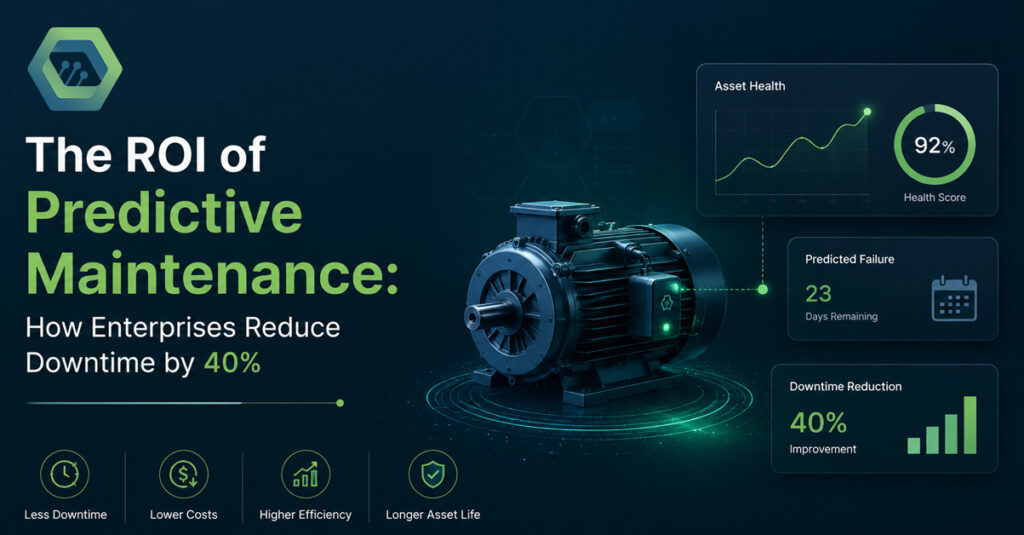
Many enterprises report downtime reductions of up to 40% after implementing predictive maintenance strategies, depending on asset type, maintenance maturity, and operational conditions.
2. Lower Maintenance Costs
Traditional maintenance often replaces components based on schedules rather than actual condition.
Predictive maintenance ensures maintenance occurs only when required.
Benefits include:
- Reduced labor hours
- Lower spare parts consumption
- Fewer emergency repairs
- Better maintenance planning
Maintenance budgets become more predictable and cost-efficient.
3. Extended Asset Life
Industrial assets represent significant capital investments.
Replacing equipment prematurely increases operational costs.
Predictive maintenance identifies performance degradation before it causes permanent damage.
This extends the operational life of:
- HVAC systems
- Pumps
- Motors
- Compressors
- Chillers
- Production machinery
- Elevators
- Utility infrastructure
Longer asset life directly improves Predictive Maintenance ROI.
4. Higher Energy Efficiency
Failing equipment rarely operates efficiently.
Motors consume more electricity.
HVAC systems work harder.
Compressors leak energy.
Predictive maintenance identifies inefficient operating conditions early.
Organizations reduce unnecessary energy consumption while improving equipment performance.
This creates measurable savings beyond maintenance alone.
5. Improved Operational Productivity
Unexpected breakdowns affect more than machines.
They impact production schedules, maintenance teams, operators, logistics, and customer commitments.
Predictive maintenance minimizes disruptions.
Operations become more stable.
Productivity improves across the organization.
Real-World Industry Applications
Manufacturing
Manufacturers integrate predictive maintenance with:
- PLCs
- SCADA
- Industrial IoT Sensors
- Production Systems
Benefits include:
✔ Improved OEE
✔ Reduced production interruptions
✔ Better machine utilization
✔ Lower maintenance costs
Smart Buildings
Commercial buildings use predictive maintenance for:
- HVAC equipment
- Chillers
- Pumps
- Elevators
- Lighting infrastructure
- Fire and safety systems
The result:
- Lower energy costs
- Improved occupant comfort
- Reduced service interruptions
Utilities
Utility providers monitor:
- Transformers
- Pumps
- Distribution systems
- Renewable energy assets
Predictive maintenance reduces outages while improving infrastructure reliability.
Logistics
Fleet operators monitor:
- Engine performance
- Fuel systems
- Tire health
- Vehicle diagnostics
Maintenance becomes proactive instead of reactive.
Fleet availability increases while operational costs decrease.
The Role of IoT in Predictive Maintenance ROI
Predictive maintenance depends on accurate, real-time data.
IoT sensors continuously monitor equipment conditions and transmit operational information to a centralized platform.
Common monitoring parameters include:
- Vibration
- Temperature
- Pressure
- Humidity
- Electrical Current
- Voltage
- Energy Consumption
- Equipment Runtime
Without IoT, predictive maintenance becomes difficult to scale.
With IoT, enterprises gain continuous visibility into asset health.
Why a Unified IoT Platform Maximizes Predictive Maintenance ROI
Collecting sensor data alone is not enough.
Organizations also need context.
A Unified IoT Platform integrates:
- IoT Sensors
- PLCs
- SCADA Systems
- Building Management Systems
- ERP
- CAFM
- CMMS
- Energy Monitoring
Instead of isolated alerts, organizations receive operational intelligence.
For example:
A vibration anomaly on a motor is automatically correlated with:
- Increased energy consumption
- Reduced production output
- Maintenance history
- Work order status
This enables faster and more accurate decision-making.
How OmniWOT Enables Predictive Maintenance ROI
OmniWOT’s Unified IoT Platform connects operational technology and enterprise systems into a single intelligence layer.
Capabilities include:
Real-Time Asset Monitoring
Monitor thousands of connected assets from one platform.
Multi-Protocol Integration
Connect SCADA, PLCs, BACnet, Modbus, MQTT, LoRaWAN, OPC-UA, and more.
Predictive Analytics
Detect equipment anomalies before failures occur.
Automated Maintenance Workflows
Automatically generate maintenance tickets and alerts through integrated CAFM and CMMS platforms.
Enterprise Dashboards
Provide executives, facility managers, and maintenance teams with real-time operational visibility.
Best Practices for Maximizing Predictive Maintenance ROI
To achieve the highest return, organizations should:
- Prioritize critical assets first
- Deploy industrial-grade IoT sensors
- Integrate OT and IT systems
- Use AI-driven analytics
- Continuously monitor asset performance
- Measure KPIs such as downtime, MTBF, MTTR, energy consumption, and OEE
- Implement predictive workflows instead of reactive responses
Frequently Asked Questions
What is Predictive Maintenance ROI?
Predictive Maintenance ROI measures the financial and operational value generated by implementing predictive maintenance technologies compared to the investment required.
How much downtime can predictive maintenance reduce?
Results vary by organization and asset type, but many enterprises report reductions in unplanned downtime of up to 40% after implementing mature predictive maintenance programs.
Which industries benefit most from predictive maintenance?
Manufacturing, Smart Buildings, Energy & Utilities, Logistics, Healthcare, Airports, Campuses, Data Centers, and Industrial Facilities.
Why is IoT important for predictive maintenance?
IoT sensors provide continuous real-time asset data that enables early fault detection, condition monitoring, and predictive analytics.
Can predictive maintenance integrate with existing SCADA or BMS systems?
Yes. Modern Unified IoT Platforms such as OmniWOT integrate with SCADA, PLC, BMS, ERP, CAFM, and CMMS systems to provide enterprise-wide predictive maintenance capabilities.
Conclusion
Predictive maintenance has evolved from a maintenance improvement initiative into a strategic business advantage.
Organizations are no longer measuring success by the number of repairs completed.
They are measuring:
- Equipment availability
- Operational efficiency
- Energy performance
- Asset longevity
- Production continuity
- Business resilience
The organizations achieving the highest Predictive Maintenance ROI are those that combine IoT sensors, AI-driven analytics, and Unified IoT Platforms into a single operational intelligence ecosystem.
Because the future of maintenance isn’t reactive.
It isn’t scheduled.
It is predictive.
And the future of operational excellence begins with knowing what will happen—before it happens.