
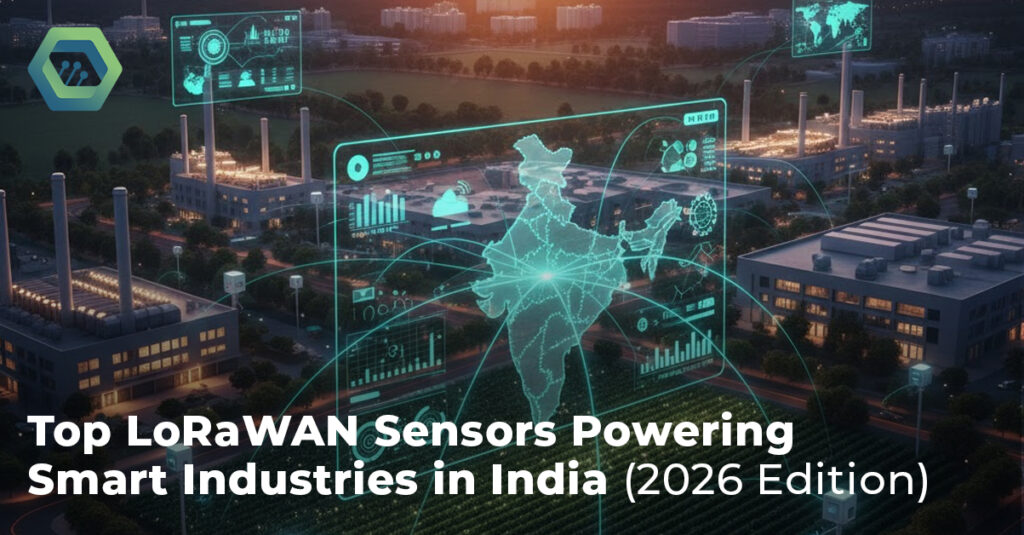
India’s industrial IoT journey in 2026 is no longer about experimentation—it’s about scale, reliability, and real business impact.
At the center of this transformation is LoRaWAN, a low-power, long-range wireless technology that enables industries to deploy sensors across vast, complex environments without heavy infrastructure.
From factories and warehouses to farms, campuses, and utilities, LoRaWAN sensors are becoming the backbone of smart industry deployments in India.
In this blog, we explore the top LoRaWAN sensors powering smart industries in India in 2026, the problems they solve, and how platforms like OmniWOT turn sensor data into actionable intelligence.
Why LoRaWAN Sensors Matter in India (2026)
India presents unique operational challenges:
- Large geographic spread
- Harsh industrial environments
- Remote and low-connectivity zones
- Cost-sensitive deployments
- Need for long battery life
LoRaWAN sensors are ideal because they offer:
- Long-range connectivity (kilometers, not meters)
- Ultra-low power consumption
- Minimal infrastructure cost
- High scalability across sites
In 2026, LoRaWAN is no longer niche—it’s mission-critical.
1. Weather & Environmental Sensors (Smart Agriculture & Infrastructure)
Use cases:
- Smart farming
- Water resource management
- Climate monitoring
- Smart cities
LoRaWAN weather stations and environmental sensors track:
- Temperature
- Humidity
- Rainfall
- Wind speed
- Atmospheric pressure
Impact:
Farmers optimize irrigation and crop planning, while cities and industries use climate data to improve resilience and planning.
2. Soil Sensors (Precision Agriculture)
Soil moisture and temperature sensors are redefining Indian agriculture.
Use cases:
- Precision irrigation
- Yield optimization
- Water conservation
Business value:
✔ Reduced water usage
✔ Higher crop yield
✔ Lower operational cost
When integrated into a unified IoT platform, soil data becomes predictive—not reactive.
3. Energy & Power Monitoring Sensors (Factories & Campuses)
Energy costs are one of the biggest operational expenses for Indian industries.
LoRaWAN energy sensors enable:
- Real-time power consumption tracking
- Equipment-level energy insights
- Peak load optimization
Result:
Industries reduce energy waste by 15–30% through data-driven decisions.
4. Gas & Air Quality Sensors (Industrial Safety)
Industrial safety is a top priority in 2026.
LoRaWAN gas and air quality sensors monitor:
- Toxic gas leaks
- CO₂ levels
- Indoor air quality
- Environmental compliance
Industries using them:
- Manufacturing
- Warehousing
- Healthcare
- Utilities
These sensors provide early warnings, preventing incidents before they escalate.
5. RTLS & Location Sensors (Asset & Workforce Tracking)
Knowing where assets and people are—at all times—is critical.
Use cases:
- Worker safety
- Asset tracking
- Emergency response
- Compliance monitoring
LoRaWAN-enabled RTLS devices and wearables provide:
- Real-time location
- SOS alerts
- Inactivity detection
6. Smart Safety Wearables (Helmets & Watches)
Industrial wearables are one of the fastest-growing IoT categories in India.
Capabilities include:
- Fall detection
- Helmet removal alerts
- High-voltage proximity warnings
- Environmental monitoring
- Solar & battery dual power
In 2026, safety wearables are becoming mandatory, not optional, across high-risk industries.
7. Controllers & Actuators (Automation Without Rewiring)
LoRaWAN controllers allow industries to:
- Control legacy equipment remotely
- Automate processes without new cabling
- Retrofit old infrastructure
This makes automation faster, cheaper, and less disruptive.
The Real Power: From Sensors to a Single Dashboard
Sensors alone don’t deliver ROI.
The real value comes when all LoRaWAN sensors connect to a unified platform—where data is:
- Centralized
- Visualized
- Correlated
- Actionable
Platforms like OmniWOT unify sensor data across:
- Energy
- Environment
- Safety
- Assets
- Operations
…into one real-time dashboard.
Why Smart Industries Choose Unified IoT Platforms in 2026
Indian enterprises are moving away from:
- Multiple sensor apps
- Disconnected dashboards
- Manual data analysis
They are adopting hardware-agnostic, multi-protocol IoT platforms that scale with their business.
Unified platforms ensure:
- Faster decision-making
- Lower operational losses
- Clear ROI visibility
- Future-proof architecture
Final Thoughts
In 2026, LoRaWAN sensors are powering the next wave of smart industries in India.
But sensors alone aren’t enough.
The winners will be organizations that:
- Choose the right sensors
- Connect them through a unified platform
- Turn data into decisions
That’s where the future of industrial IoT is headed.
Call to Action
Looking to deploy LoRaWAN sensors at scale?
Discover how OmniWOT connects sensors, platforms, and industries into one intelligent ecosystem.