

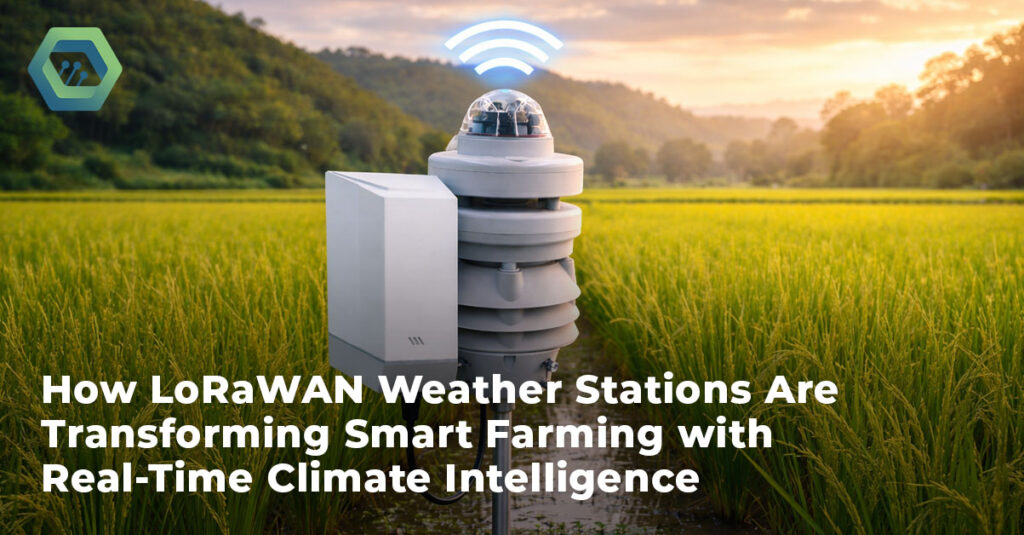
In the rapidly evolving landscape of Smart Agriculture, data is the new “gold.” As we navigate 2026, the global agricultural sector is facing unprecedented challenges: unpredictable weather patterns, water scarcity, and a growing need for sustainable practices. Enter the LoRaWAN weather station—a game-changing piece of climate intelligence that is moving farming from guesswork to precision.
But what makes LoRaWAN the preferred choice for modern growers over traditional cellular or Wi-Fi systems? Let’s dive into how this technology is reshaping the future of food production.
What is LoRaWAN and Why Does Agriculture Need It?
LoRaWAN (Long Range Wide Area Network) is a low-power, wireless protocol designed to connect battery-operated “things” to the internet over vast distances. In a farm setting, where fields can span hundreds of acres and cellular signals are often weak, LoRaWAN provides a robust backbone for Internet of Things (IoT) devices.
Key Advantages for Farmers:
- Extreme Long Range: A single gateway can receive data from sensors up to 15km away in open rural terrain.
- Low Power Consumption: Sensors can last 5 to 10 years on a single battery, drastically reducing maintenance labor.
- Deep Penetration: Signals easily pass through dense crops, foliage, and even farm buildings.
- Cost-Effectiveness: Operating on unlicensed spectrums means no monthly SIM card fees for every sensor.
Real-Time Climate Intelligence: Beyond the Forecast
Traditional weather apps provide general data for a city or region. However, a LoRaWAN-enabled weather station offers hyper-local climate intelligence. It captures micro-climates within specific blocks of a farm, providing data on:
- Air Temperature & Humidity: Critical for predicting frost and heat stress.
- Rainfall & Wind Speed: Essential for precise irrigation and knowing when it’s safe to spray fertilizers or pesticides.
- Solar Radiation: Helps calculate Evapotranspiration (ET) to understand exactly how much water crops are losing.
- Barometric Pressure: Assists in short-term local forecasting for immediate operational changes.
Transforming Farm Operations: 3 Major Use Cases
1. Precision Irrigation & Water Conservation
By integrating weather data with soil moisture sensors, farmers can automate irrigation. Instead of watering on a fixed schedule, the system only activates when the soil is dry and no rain is forecasted.
Impact: Many farms report up to a 30% reduction in water usage while maintaining or increasing yields.
2. Disease and Pest Prediction
High humidity and specific temperature ranges are breeding grounds for fungi and pests. Real-time data allows AI-driven platforms to send early warning alerts to farmers, enabling them to apply treatments only where and when needed, reducing chemical use.
3. Frost Protection and Harvest Planning
For high-value crops like grapes or almonds, a sudden frost can be a multi-million dollar disaster. LoRaWAN weather stations provide real-time alerts to a farmer’s smartphone, triggering wind fans or heaters the moment temperatures dip below a critical threshold.
The ROI of LoRaWAN in 2026
The Professional Weather Stations Market is projected to grow significantly through 2032, and for good reason. The Return on Investment (ROI) is no longer theoretical. With the ability to scale to thousands of sensors—tracking everything from livestock health to grain silo levels—LoRaWAN is the most scalable infrastructure for a “connected farm.”
| Feature | Traditional Weather Station | LoRaWAN Weather Station |
| Connectivity | Manual/Wired/Cellular | Wireless (Long Range) |
| Data Cost | High (Monthly SIM fees) | Low (Private Network) |
| Battery Life | Months | 5–10 Years |
| Scalability | Limited | High (Thousands of nodes) |
Conclusion: The Future is Data-Driven
As we look toward a more sustainable future, LoRaWAN weather stations stand at the forefront of the AgTech revolution. They provide the “eyes and ears” on the ground, allowing farmers to adapt to climate change with confidence and precision. By leveraging real-time climate intelligence, smart farms aren’t just surviving; they are thriving.