
From Fragmented Operations to a Unified Digital Nervous System
Industrial enterprises have spent years investing in technology.
Factories today are filled with:
• Automation systems
• ERP platforms
• SCADA environments
• PLC networks
• Energy monitoring tools
• IoT devices and analytics software
Yet despite all this investment, many operations still struggle with inefficiency, delays, and disconnected decision-making.
The issue is not lack of technology.
👉 The issue is lack of synchronization.
The Real Problem Isn’t Capability — It’s Fragmentation
Most industrial enterprises already have the tools they need.
The challenge is that these systems often operate independently:
• SCADA operates separately from ERP
• Maintenance systems are disconnected from machine data
• Energy monitoring exists in isolation
• IoT sensors generate data with no operational integration
The result?
❌ Data silos
❌ Delayed response times
❌ Manual coordination
❌ Operational blind spots
❌ Reduced efficiency at scale
Enterprises are surrounded by data—
but disconnected systems prevent that data from becoming operational intelligence.
The Next Competitive Advantage is Not Automation—It Is Integration
For years, automation was the focus of industrial transformation.
Companies invested heavily in:
✔ Robotics
✔ Smart machines
✔ Automated production lines
✔ Digital control systems
But automation without synchronization creates isolated intelligence.
Modern industrial ecosystems require something more powerful:
👉 Unified operational coordination
The next era of industrial efficiency will not be defined by how many systems an enterprise owns—
but by how intelligently those systems work together.
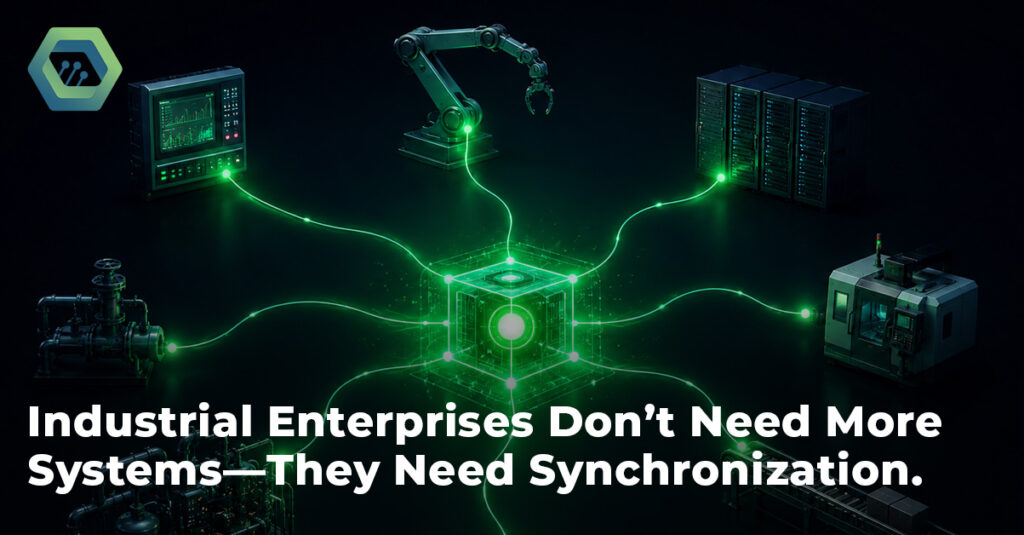
From Systems to a Digital Nervous System
Think of a modern industrial enterprise like a human body.
Machines, sensors, production lines, utilities, and software platforms are all individual organs.
But without a nervous system connecting them, there is no coordinated intelligence.
A Unified Industrial IoT Platform acts as that digital nervous system.
It enables:
• Real-time communication between systems
• Instant operational visibility
• Automated cross-functional workflows
• Centralized intelligence across facilities
👉 From disconnected components to synchronized operations.
What Industrial Synchronization Actually Means
Industrial synchronization is the seamless coordination of:
• Machines
• SCADA systems
• PLCs
• ERP platforms
• Energy systems
• Maintenance workflows
• IoT sensors
• Analytics platforms
All operating within one connected operational ecosystem.
Instead of systems reacting independently,
they respond as a synchronized network.
Why Traditional Industrial Architectures Struggle
Many industrial infrastructures evolved over decades.
This creates environments with:
• Legacy systems
• Multiple communication protocols
• Separate vendor ecosystems
• Different data formats
• Isolated operational dashboards
Even highly automated plants often depend on manual coordination between departments and systems.
👉 Automation exists.
👉 Synchronization does not.
The Role of Industrial IoT in Synchronization
Industrial IoT acts as the bridge between physical operations and digital intelligence.
Through IoT integration:
• Machines become data-aware
• Systems communicate in real time
• Assets become operationally visible
• Data flows across departments instantly
This creates:
✔ Faster decision-making
✔ Predictive insights
✔ Intelligent automation
✔ Enterprise-wide visibility
Unified Platforms: The Core of Connected Operations
The future of industrial efficiency lies in unified platforms.
Modern enterprises need systems that can integrate:
• ERP
• SCADA
• PLCs
• BMS
• Energy systems
• Maintenance software
• Edge devices
• Cloud analytics
Into a single operational layer.
👉 One ecosystem. One intelligence layer.
Edge-to-Cloud: Enabling Real-Time Synchronization
Industrial synchronization depends on speed and scalability.
This is enabled through Edge-to-Cloud architecture.
Edge Layer
• Local machine processing
• Real-time control
• Immediate response
Cloud Layer
• Enterprise analytics
• Multi-site visibility
• Predictive intelligence
Together, they create synchronized industrial ecosystems capable of operating at global scale.
From Reactive Operations to Intelligent Coordination
Traditional industrial operations are reactive.
Problems are identified after disruption occurs.
Synchronized operations enable:
✔ Predictive maintenance
✔ Automated alerts
✔ Cross-system responses
✔ Dynamic energy optimization
✔ Real-time operational adjustments
This transforms industrial operations from:
❌ Reactive workflows
to
✅ Intelligent, self-coordinated ecosystems
Real-World Industrial Synchronization Scenarios
Manufacturing Plants
Machine anomalies automatically trigger maintenance workflows and production adjustments.
Energy & Utilities
Energy loads dynamically optimize based on operational demand.
Multi-Site Enterprises
Centralized dashboards synchronize operations across countries and facilities.
Smart Factories
Machines, sensors, ERP, and SCADA systems operate as one intelligent network.
Business Impact of Industrial Synchronization
Organizations adopting integrated operational ecosystems achieve:
Higher Operational Efficiency
Reduced manual coordination and faster execution
Reduced Downtime
Predictive insights prevent operational disruptions
Better Decision-Making
Real-time intelligence across departments and facilities
Lower Operational Costs
Optimized energy, maintenance, and resource utilization
Enterprise Scalability
Operations scale without increasing complexity
Synchronization Is the Foundation of Industry 4.0
Industry 4.0 is not just about smart machines.
It is about creating:
• Connected ecosystems
• Real-time intelligence
• Autonomous coordination
• Data-driven operations
Synchronization is what transforms isolated automation into true industrial intelligence.
OmniWOT: Enabling the Unified Industrial Ecosystem
OmniWOT connects industrial systems into a single enterprise-grade platform.
By integrating:
• SCADA
• PLCs
• ERP systems
• IoT devices
• Energy infrastructure
• Operational analytics
OmniWOT enables enterprises to build a synchronized digital nervous system for industrial operations.
👉 Real-time visibility
👉 Cross-system intelligence
👉 Enterprise-wide synchronization
Conclusion
Industrial enterprises do not need more disconnected tools.
They need synchronization.
Because in the next generation of industrial operations:
👉 The competitive advantage will not come from automation alone.
👉 It will come from how intelligently systems work together.
The future belongs to enterprises that transform fragmented operations into synchronized, intelligent ecosystems.
FAQ
What is industrial system integration?
Industrial system integration connects machines, software, sensors, and operational systems into one unified ecosystem.
Why is synchronization important in industrial operations?
Synchronization enables real-time communication, operational visibility, and coordinated automation across systems.
How does Industrial IoT improve synchronization?
Industrial IoT enables machines and systems to share real-time data and operate as a connected ecosystem.
What systems are typically integrated in Industry 4.0?
ERP, SCADA, PLCs, IoT sensors, BMS, maintenance systems, and analytics platforms.