


Modern Facility Management is no longer about isolated systems.It requires a connected digital ecosystem where IoT devices, M2M communication, automation systems, and maintenance workflows operate as one unified infrastructure. OmniWOT delivers exactly that —An enterprise-grade, IoT-enabled CAFM & CMMS platform purpose-built for large, multi-site portfolios. IoT & M2M: The Core of Smart Facility Management Every asset in a facility generates

BMS can’t be replaced — but IoT is the layer that unlocks its full value. Building Management Systems remain the backbone of smart buildings. They reliably operate HVAC, chillers, electrical infrastructure, and life safety systems using BACnet and Modbus protocols. That foundation isn’t changing. What is changing is client expectation. Today’s enterprises demand: Traditional control alone is no longer enough.
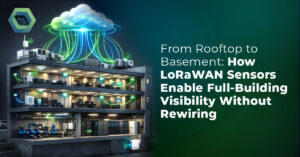
LoRaWAN sensors are transforming smart building automation by enabling full-building visibility—from rooftop HVAC units to basement utilities—without costly rewiring.

Traditional BMS systems are no longer enough. Discover how Integrated Building Management Systems powered by IoT are transforming energy efficiency, real-time monitoring, and smart infrastructure in 2026.
Location intelligence powered by IoT sensors and RTLS is transforming smart factories, hospitals, and campuses by enabling real-time asset visibility, safety monitoring, and operational efficiency.

Industrial wearables such as smart helmets and watches are transforming safety audits by enabling real-time monitoring, incident detection, and proactive workplace safety.
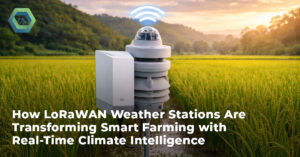
In the rapidly evolving landscape of Smart Agriculture, data is the new “gold.” As we navigate 2026, the global agricultural sector is facing unprecedented challenges: unpredictable weather patterns, water scarcity, and a growing need for sustainable practices. Enter the LoRaWAN weather station—a game-changing piece of climate intelligence that is moving farming from guesswork to precision. But what makes LoRaWAN the
India’s industrial IoT journey in 2026 is no longer about experimentation—it’s about scale, reliability, and real business impact.At the center of this transformation is LoRaWAN, a low-power, long-range wireless technology that enables industries to deploy sensors across vast, complex environments without heavy infrastructure. From factories and warehouses to farms, campuses, and utilities, LoRaWAN sensors are becoming the backbone of smart
In the vast, steel-laden corridors of a manufacturing plant or the subterranean tunnels of a deep-shaft mine, the Global Positioning System (GPS) is effectively blind. For high-risk industries, this “blind spot” isn’t just an operational nuisance—it’s a critical safety risk. As we move through 2026, the industry is moving Beyond GPS. The convergence of LoRaWAN and Ultra-Wideband (UWB) is creating

In the manufacturing world of 2026, the sound of a machine breaking down is becoming a relic of the past. For decades, factory managers were trapped in a cycle of “fix it when it breaks” (reactive) or “fix it even if it’s fine” (preventative). Both are expensive. One leads to catastrophic production halts; the other leads to wasted parts and

By 2026, IoT in India has moved decisively from experimentation to enterprise-scale execution.Factories, hospitals, campuses, warehouses, and smart infrastructure projects are no longer asking if they should deploy IoT—but how to scale it without losing control, visibility, or ROI. As deployments mature, one trend stands above the rest: 👉 Unified data platforms are outperforming single-protocol IoT systems—by a wide margin.

Industrial safety is undergoing a fundamental shift.In 2025, safety is no longer limited to helmets, badges, or manual supervision. It’s becoming intelligent, connected, and proactive — powered by industrial IoT wearables. Across construction sites, factories, mines, oil & gas facilities, logistics hubs, and campuses, smart helmets and smart watches are emerging as critical tools that don’t just protect workers —